
Coal flexibilisation is the key to unlocking India’s renewable energy potential
Download the coal flexibilisation report click here
New Delhi, August 22, 2026: India is witnessing a rapid growth in its renewable energy sector, but with its power grid still relying largely on coal-fired plants, is the country ready to make that much-needed transition to clean energy? How will both coexist and integrate?
“That is our central challenge,” says Sunita Narain, Director General of Centre for Science and Environment (CSE). “The growth and transformation that India’s power sector is witnessing has meant that we must work towards greater flexibility in the grid. Enhancing the flexibility of the existing coal fleet can play a role in balancing the system and enabling greater integration of renewable energy.”
“We are not talking about renewable vs coal here. We are talking about renewable and coal, and about how to integrate the two. The task is not to replace coal, but to displace it,” adds Narain.
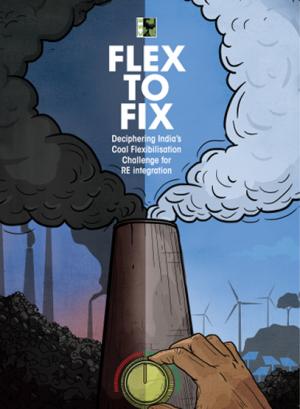
She was speaking here at a national dialogue organised by CSE on the subject of coal flexibilisation and how the country can achieve its energy transition goals seamlessly. CSE released two new reports on the occasion -- Flex to Fix: Deciphering India’s coal flexibilisation challenge for RE integration and Beyond Baseload: Reforming thermal PPAs for India’s energy transition.
The Dialogue brought together some key experts and stakeholders from organisations such as the Central Electricity Authority (CEA), the Central Electricity Regulatory Commission (CERC), GRID-India, Bharat Heavy Electricals Limited (BHEL), National Thermal Power Corporation (NTPC) and Torrent Power, along with representatives from think tanks, the civil society and academia.
The discussions revolved around the primary agenda: to reach a consensus on how coal power flexibilisation and reforms in thermal power purchase agreements (PPAs) can enable greater renewable energy integration and grid stability, while keeping costs low for consumers.
Besides Narain, the other keynote experts and stakeholders who spoke at the Dialogue’s inaugural session were M M Chaudhari, Joint Chief, CERC; B C Mallick, Principal Chief Engineer II, CEA; Rajiv K Porwal, Director (System Operations), GRID India; and Dr Umakanta Panda, Secretary, Madhya Pradesh ERC.
India’s energy transition challenge: Coal flexibilisation
The first of these CSE studies -- Flex to Fix: Deciphering India’s coal flexibilisation challenge for RE integration – points out that India achieved a significant milestone in November 2025 by reaching 50 per cent non-fossil-based installed power capacity, five years ahead of its original 2030 target.
Says Parth Kumar, Programme Manager, Sustainable Industrialisation unit, CSE and one of the lead writers of the two reports: “The problem, however, is the rapid growth in RE (renewable energy), particularly solar energy -- which has seen a 3.5-fold capacity increase in the last six years and now exceeds 160 GW -- has fundamentally altered the demand-supply balance in the grid. This has resulted in creation of deep variability and operational stress across the day in conventional generation, leading to instability in the national power grid. The consequences have been significant economic and environmental losses.”
In 2024, GRID-India recorded multiple days in which the grid frequency breached the threshold of 49.9-50.05 Hz, risking blackouts owing to over-injection by thermal units, more than what was required. The risk has risen subsequently with greater year-on-year solar energy penetration, says the CSE report.
Clarifying what ‘coal flexibilsation’ means, Kumar explains: “Think of a coal power plant like a tap that traditionally runs at almost the same flow. Coal flexibilisation means modifying the plant so that this tap can be turned down or turned up more quickly depending on what the grid needs. When solar and wind are producing plenty of electricity, the coal plant can reduce its output. When renewable generation falls -- such as during night-time -- or demand rises, it can quickly increase generation again.”
He adds that this requires “changes to the plant’s equipment and controls, along with changes in how it is operated. Plants need to be able to safely operate at lower loads, ramp generation up and down faster, and withstand more frequent start-ups and shutdowns. This may involve upgrades to control systems and other equipment, better maintenance and fuel management, and training operators for more flexible operation.”
Benefits of coal flexibilisation
Kushagra Goyal, Senior Research Associate, Sustainable Industrialisation unit, CSE, and another author of the report, says: “Our research shows coal flexibilisation remains a cost-effective option. In fact, the systemic benefits of flexibilisation extend beyond cost-effectiveness and can provide much greater flexibility to the power grid. Gas, hydro and battery storage are significant and critically important solutions, but with coal still continuing to be the largest source of power, we cannot overlook its role in meeting the system-wide flexibility needs of an evolving power system.”
The CSE study offers strong arguments in support of coal flexibilisation:
Speaking at the report release, B C Mallick, Principal Chief Engineer II, Central Electricity Authority agreed with CSE: “Flexibilisation offers a low-cost, technically feasible solution that can be deployed immediately.”
CSE recommends…
Speaking at the Dialogue, Nivit K Yadav, Programme Director, Sustainable Industrialisation unit, CSE said: “Thermal power plants need policy certainty to plan the retrofits and align their schedule to incorporate these recommendations. Flexibilisation is the bridge between today's coal-dependent system and a future renewable-dominant grid. Without redressal and correction in implementation and regulatory alignment, India risks undermining the hard-won gains of its renewable energy transition.”
For more on this, please connect with Souparno Banerjee at souparno@cseindia.org, 9910864339.
Share this article