
India’s non-fossil based installed capacity has surpassed fossil-based capacity, fundamentally reshaping the power grid. Over the past decade, the share of solar energy has increased 3.5-fold to reach 140 GW, and with 100+ GW under construction, the daily power generation mix is now permanently altered. Coal-based thermal energy operations are shifting from consistent baseload to a more adaptable role, accommodating RE generation, especially during daytime. The unified national GRID requires flexibility from its largest energy resource.
| Coal flexibilisation report (Abridged version) | |
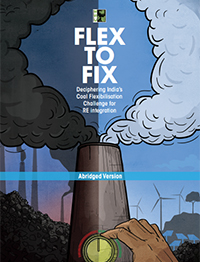 |
Abridged version containing Executive summary, Key findings, Recommendations and select visuals for the report. |
To equip the fleet to operate flexibly, the Government of India notified the Central Electricity Authority (Flexible Operation of Coal-based Thermal Power Generating Units) Regulations, 2022 on January 25, 2023. The phasing plan aims to transition India’s coal fleet to a minimum technical load of 40 per cent while enhancing each unit’s ramping ability above one per cent per minute.
This report examines India’s progress in implementing coal flexibilisation while evaluating the technical, economic, regulatory, and institutional barriers shaping the transition. It assesses the costs of integrating flexible operations via retrofits and draws lessons from international experience in China, Chile, and Germany. Through system-level appraisal and policy analysis, the report highlights the decarbonisation potential embedded in accelerating its execution. Built with inputs from sector experts, the research aims to strengthen regulatory and tariff frameworks, empowering coal-based thermal power to support higher RE integration while maintaining grid reliability and affordability.
FOR FURTHER DETAILS AND INFORMATION, PLEASE CONTACT
PARTH KUMAR
Programme Manager
Sustainable Industrialization Unit, CSE
parthkumar@cseindia.org
+91 9839061000
KUSHAGRA GOYAL
Senior Research Associate
Sustainable Industrialization Unit, CSE
kushagra_goyal@cseindia.org
+91 9799436833


Share this article