
Free download of the CSE report.
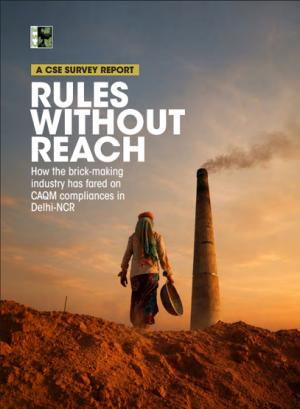
New Delhi, June 2026: A new survey report by the Centre for Science and Environment (CSE) has found that the brick-making sector in Delhi-NCR remains in open, widespread violation of the Commission for Air Quality Management's (CAQM) ban on coal, with no credible enforcement mechanism, no monitoring system, and no transition support from regulatory authorities to the industry. The report, Rules Without Reach: How the Brick-Making Industry Has Fared on CAQM Compliances in Delhi-NCR, is based on two rounds of field surveys covering 128 kilns in 2025 and 152 kilns in 2026 across Baghpat, Ghaziabad, Bulandshahr, Shamli, Jhajjar, Panipat, and Sonipat, and virtual communications with 60 kiln owners.
"The brick industry is among the most polluting and least regulated sectors in the country. The CAQM coal ban was a necessary step, but a direction without a transition strategy is unlikely to change behaviour on the ground. The sector needs technical guidance, financial support, and institutional hand-holding. None of that was provided, and the survey results reflect exactly that gap," says Subhrajit Goswami, Programme Officer, CSE.
What did the CSE Survey find
Why the Transition Has Not Happened
The quality and price of a brick depends on how well it is fired, and reaching the required temperature consistently using biomass alone is not straightforward. The core issue comes down to quality and economics. Kiln owners consistently maintained that coal is essential for producing good quality bricks, as biomass does not have the same calorific value, coal typically offers 4,000 to 6,000 kcal/kg, while most crop residues provide only 3,000 to 4,000 kcal/kg. Most owners said a blend of at least 20 to 30 per cent coal with 70 to 80 per cent biomass is the minimum needed to maintain product quality. Going to zero coal, as the mandate requires, is something the sector is not technically ready for, and the research needed to get it there has not been done at the scale required.
There is also a competitive disadvantage built into how the mandate is currently structured. It applies only to NCR, whereas brick kiln outside the NCR boundary can use coal freely, fire bricks to a higher quality, and sell them at a better price.
Recommendations
The shift to cleaner fuels involves system-level modifications that require specialised technical knowledge. Regulatory authorities must identify sector experts to develop standard operating procedures for fuel transition and fuel-feeding mechanisms, and formally engage institutions such as CBRI Roorkee and the Punjab State Council for Science and Technology. Punjab offers a model worth following: the state undertook R&D on partially replacing coal with paddy straw pellets before issuing a mandate, made compliance with the CSIR-CBRI kiln design mandatory for any Consent to Operate, and built a system of hands-on support that has since attracted interest from Nepal and other states, with inter-governmental bodies like ICIMOD exploring replication across South Asia. The combination of research, regulation, and institutional hand-holding is exactly what the NCR needs.
The Supreme Court-mandated four-month window cannot be a long-term solution. On the ground, fuel-use and production volumes go largely unchecked within those four months. The short season also creates a labour problem. Workers cannot depend on four months of employment and move on to other jobs once the season ends, making any sustained effort on labour welfare nearly impossible. Weather uncertainty adds further pressure, early monsoons cut into the window, and reheating kilns after an unexpected break consumes additional fuel. Kilns that have invested in clean technology and adequate infrastructure should be considered for year-round operation, excluding winter, to make the economics of compliance viable and create a real incentive to upgrade.
Alongside, PCB regional offices are already stretched across multiple industries, and brick is one of the few sectors with no continuous air quality monitoring. Building PCB field capacity and enabling remote compliance tracking are essential. Quality standards for briquettes and pellets must also be established and enforced, and public procurement preferences for bricks manufactured with cleaner fuels would help generate the market demand that makes compliance economically rational.
“India's demand for building materials will continue to grow. What the brick sector needs is not just restrictions; red bricks need clear benchmarks. The larger goal should be to define what a well-run brick kiln looks like—one that operates year-round with effective pollution controls, provides stable employment for workers, and remains economically viable,” Nivit Kumar Yadav, Programme Director, Sustainable Industrialisation and Renewable Energy unit, CSE.
Yadav adds: “The country needs a National Brick Mission with a clear policy roadmap for the sector, driven from the highest levels of government, along with blended finance opportunities for entrepreneurs. Achieving this will require coordinated action by regulators, researchers, industry, and civil society".
For more information, interviews etc, please contact Sukanya Nair of The CSE Media Resource Centre: sukanya.nair@cseindia.org, 8816818864
| Report | ||
 |
Rules Without Reach | |
Share this article