
400+ Indian cities have zero urban transport buses; 70 per cent deficit in urban transit; Rs 14.2 lakh crore needed for an overhaul
Download a free copy of the study report click here
NEW DELHI, August 10, 2026: India faces a massive gap in its urban bus transport systems. The urban population is projected to surge from 490 million in FY2026 to 763 million by FY2047, adding 270 million city dwellers. Compared to this, the current bus availability falls dangerously shortaqe: there is a 70 per cent deficit in urban transit, says a new study conducted jointly by Centre for Science and Environment (CSE) and CITIES Forum, a global technical firm.
Over 400 Indian cities do not have any urban transport buses. To eliminate bus service backlogs, the country’s bus fleet must expand 10-fold from the current 65,000 to 6.71 lakh buses by 2047; it must also replace high-polluting diesel fleets and achieve zero-emission targets. This, along with depot, grid and charging infrastructure, demands a cumulative investment of Rs 14.20 lakh crore (~US $165 billion) over two decades, says the study.
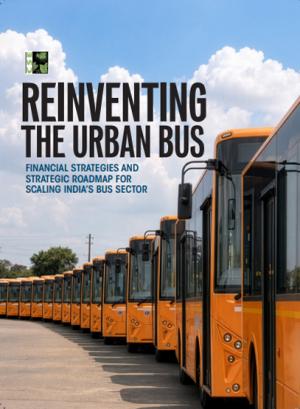
The new study -- Reinventing The Urban Bus -- examines sector deficits and lays out the strategic expansion required to serve a growing urban population, fulfil Ministry of Housing and Urban Affairs’ (MoHUA) service-level benchmarks, and build physical and electrical infrastructure.
“Transforming bus transit is a critical imperative for clean air, energy security and climate action under Viksit Bharat 2047," says Anumita Roychowdhury, Executive Director of Research and Advocacy at CSE. "Buses are the prime movers of this transition, capable of taking 40 to 50 private cars off the roads per bus to secure a 70-75 per cent public transport share. Achieving this requires a clear view of transition costs, financial requirements, grid needs and sector reforms. This study seeks launching of a Bus Mission and offers a comprehensive roadmap to deploy fiscal instruments and shift toward results-based financing that guarantees verifiable, high-quality service and full fleet electrification for every city with over 500,000 residents," she added.
Methodology: To quantify investment requirements, the study used a quantitative demand model covering all 35 states and Union territories of India. Drawing on Vahan registrations, CIRT STU statistics, UN projections and MoHUA benchmarks, the framework analyses six core components including projecting state-wise urban population growth; applying MoHUA’s graded benchmarks (40, 50, and 60 buses per lakh population based on city size and infrastructure requirements); reconstructing active fleets into 15-year age cohorts; estimating gross procurement across expansion, annual retirements, and backlog clearance; charting electrification up to a 100 per cent EV share for new purchases; and calculating total capital expenditure (CapEx) to structure a blended financing stack.
Key findings
Urban India’s bus deficit -- severe shortfalls, aging fleets and economic distress: Out of 14.5 lakh registered buses nation-wide and 2.9 lakh State Transport Undertaking (STU) stage-carriage buses, only about 65,000 operate as organised urban city buses. This provides just 13.3 to 13.8 buses per lakh urban population -- a 70 per cent shortfall against the government benchmark of 44 per lakh. Consequently, over 400 cities with populations between 100,000 and 1,000,000 completely lack an organised bus transit system.
Severe geographical disparities exist, as five states -- Madhya Pradesh, West Bengal, Uttar Pradesh, Maharashtra and Karnataka -- concentrate 55 per cent of the active national fleet. Compounding the shortage, 40,000 urban buses in service are overaged (past their 15-year statutory life), burning 20-30 per cent more fuel and incurring maintenance costs of Rs 15 to Rs 20 per kilometer. Nationwide, an unprecedented 5.8 lakh buses across all categories will reach end-of-life between FY2026 and FY2030. Deep financial distress persists within STUs, where accumulated losses frequently surpass annual operating revenues due to inefficient cost-recovery structures.
Upscale bus procurement: To meet the Viksit Bharat scenario, India must scale its average urban bus procurement rate 17-fold, rising sharply from ~2,500 buses annually to an average of 41,500 per year across three strategic waves including the Catch-Up phase (FY2027-31) requiring 44,000 to 50,000 buses annually to clear backlogs; the Stabilisation phase (FY2032-41) stabilising at 9,000 to 36,000 buses annually to absorb population growth; and the Replacement phase (FY2042-46) peaking at 71,000 to 78,000 buses annually as the initial catch-up fleet hits its 15-year statutory retirement limit.
Expanding manufacturing capacity: Meeting peak demand (~78,000 buses/year) requires expanding India's bus manufacturing ecosystem which is an opportunity to build the bus industry. Although the top five OEMs nominally possess an annual electric bus capacity of ~40,500 units, current EV manufacturing operates at under 10 per cent utilisation. Scaling up necessitates capital investments in body-building, supply chain localisation and quality assurance.
Grid impact and power readiness for upscaled electrification: Reaching a 100 per cent EV share in new procurements by FY2039-40 culminates in 6.04 lakh electric urban buses in service by 2047. Powering this zero-emission fleet requires 121 GWh of active battery capacity and an annual electricity demand of ~37,000 MU -- a fully manageable 1.8 per cent of India's total 2024 power generation.
What will it cost? The cost of transition is projected for three growth scenarios. The conservative scenario reaches 44 buses per lakh population by 2047, maintaining a 3.36-lakh bus fleet via 4.2 lakh procurements at a CapEx of Rs 6.55 lakh crore. The accelerated scenario meets MoHUA benchmarks by 2030 and lifts provision to 60 buses per lakh by 2040, operating 4.58 lakh buses via 6.8 lakh procurements at Rs 10.55 lakh crore. The recommended target scenario matches global standards of 88 buses per lakh by 2047, expanding the operational fleet to 6.71 lakh buses (90 per cent electric), and 9.1 lakh procurements, requiring a total CapEx of Rs 14.20 lakh crore.
Financial requirements and architecture: Meeting the Rs 14.20 lakh crore requirement exceeds the capacity of piecemeal schemes like FAME or PM e-Bus Sewa. With expected central funding covering ~30 per cent of capital costs, a 70 per cent funding gap (~Rs 9.9 lakh crore) must be mobilised from state budgets, private equity under Gross Cost Contracts (GCC), commercial banks, green bonds and multilateral banks. The study advocates launching a National Urban Bus Mission (NUBM) anchored by a National Urban Bus Electrification Fund (NUBEF), a committed corpus jointly funded by the Centre, states and multilateral institutions.
NUBEF will provide first-loss guarantees, concessional debt at 4-5 per cent, and credit enhancement. This will be reinforced by Green Bus Bonds, targeted Viability Gap Funding (VGF), and Results-Based Financing linked to verified outcomes.
Reforming operations for bankability: Finance must follow reforms to transform loss-making entities into investment-grade operations. Achieving bankability requires establishing independent fare authorities with automatic fare-revision mechanisms indexed to inflation and fuel/power costs while keeping the fares affordable; standardising GCC for deployments exceeding 100 buses to transfer demand risk to public authorities while holding operators to service-level performance; executing financial restructuring for stressed STUs to achieve investment-grade ratings by FY2030; and strengthening governance through Unified Metropolitan Transport Authorities (UMTAs) and statutory City Mobility Plans. This will also require private bus sector integration.
Implementation roadmap: The next five years will decide the next 15, as running the upcoming fleet retirement wave in mission mode represents the fastest route to a world-class, zero-emission urban bus system for Viksit Bharat 2047.
Priority actions:
For more details, interviews etc, please connect with Sukanya Nair of The CSE Media Resource Centre, sukanya.nair@cseindia.org, 8816818864.
Share this article