
Delhi-NCR emerges as largest regional hotspot; Chandigarh, Jaipur, Ahmedabad, Mumbai, Chennai, Bengaluru, Patna… severely affected
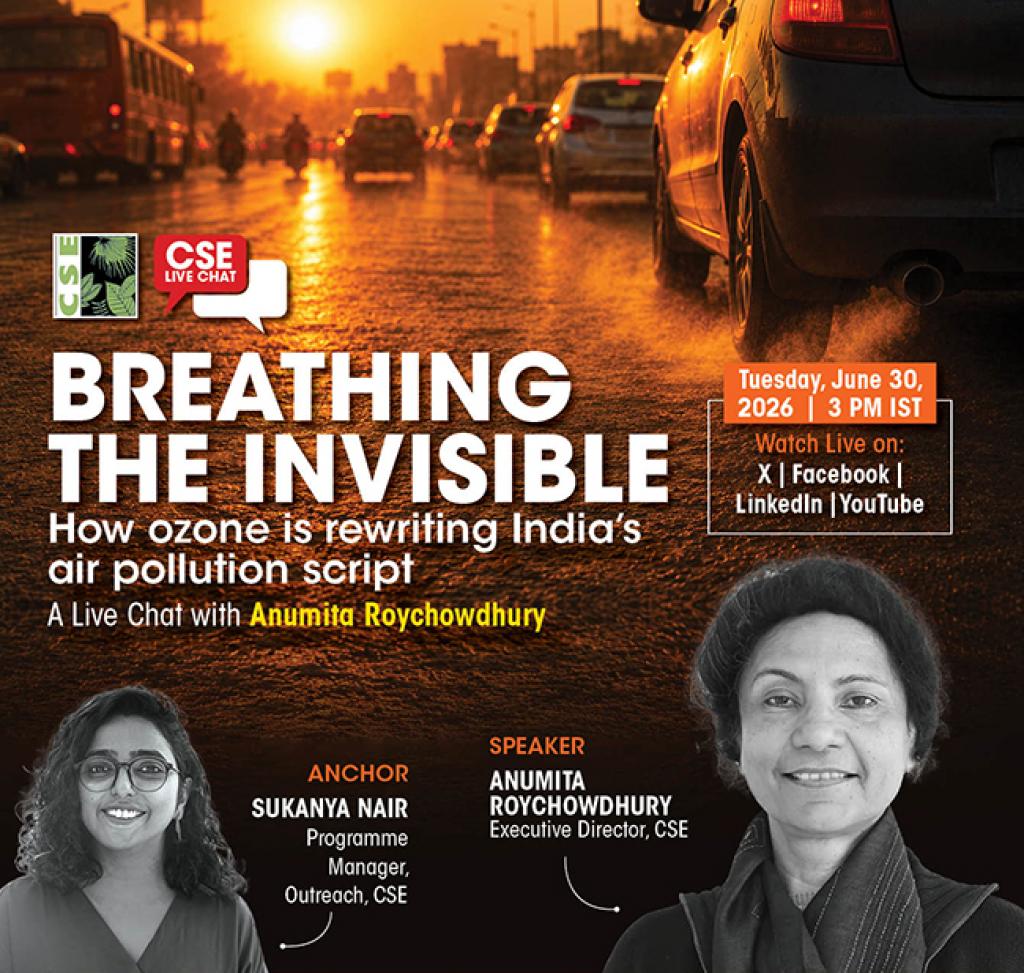
TUNE IN TODAY TO OUR CSE LIVE CHAT ON THIS SUBJECT WITH ANUMITA ROYCHOWDHURY click here
NEW DELHI,June 30, 2026: A comprehensive six-year data analysis (2021-2026) done by Centre for Science and Environment (CSE) has revealed that ground-level ozone (O3) has expanded beyond isolated, short-lived spikes to become a widespread, year-round urban and regional problem in different regions of the country – and Delhi-NCR is emerging as the largest regional hotspot.
Driven by intense and rising heat, bright sunlight and rising emissions of gases that form ozone, this invisible secondary pollutant is transforming the country's air quality profile and associated risks.
“Our analysis reveals that rising ground-level ozone and prolonged exposure windows are transforming India's localised, winter-time particulate problem into a year-round, transboundary crisis that peaks during the summeracross all regions. Ozone is damaging public health, agricultural productivity and regional climate systems. As a climate pollutant, ozone traps heat in the air, which raises temperatures and causes even more ozone to form, creating a dangerous feedback loop,” says AnumitaRoychowdhury, executive director, CSE and the lead researcher and author behind the CSE analysis.
“While the current national clean air programme (NCAP) focuses particulate matter reduction, NCAP 2.0 must adopt a multi-pollutant strategy. By targeting precursor gases like NOx and VOCs that form ozone in the air, the new framework can accelerate the shift toward clean combustion, zero-emission pathways and integrated regional airshed management,”Roychowdhury adds.
“Six years of data reveal that ground-level ozone is intensifying with higher number of days exceeding the standards, lengthening of daily exposure especially during summer, and persistence during nights due to atmospheric trapping. More ozone hotspots are proliferating in different regions of India,” adds Sharanjeet Kaur, deputy programme manager, Urban Lab, CSE and the co-author.
The key findings
Widespread exposure:Of 25 major Indian cities analysed between March 1 and May 10, 2026, 15 recorded summertime averages well above the National Ambient Air Quality Standard (NAAQS) of 100 microgrammeper cubic metre (μg/m3) for a maximum eight-hour exposure. Chandigarh recorded the highest average summer ozone concentration among all cities. Jaipurrecorded the second-highest ozone concentration. Delhi-NCR recorded the most persistent summer ozone pollution, with 71 and 62 exceedance days, respectively, followed by Bhopal (60), Bengaluru (55), Patna (24) and Muzaffarpur (21). Ahmedabadrecorded the third-highest average summer ozone concentration.
Emerging geographic hotspots – shifting focus from northern India to other regions: The problem has expanded far beyond traditional pollution zones, heavily concentrating in northern and western India. Chandigarh registered the highest summer-time average at a striking 173 μg/m3, followed by Jaipur (120), Ahmedabad (115) and Bhopal (109). Mumbai exhibited a near year-round ozone footprint, with recurring exceedance clusters from January to April and again during November-ecember, indicating that ozone is no longer only a summer problem. Chennairecorded the highest episodic ozone concentration among all cities. Bengaluruis increasing spatial spread and prolonged ozone exposure.
Delhi-NCR is the epicentre of the problem: Delhi-NCR exceeded the eight-hour national standard every single day during the 71-day study period. Within the capital, a widespread layer of toxic ozone uniformly blankets the monitoring network, with an average of 8.79 stations in active violation daily. NCR towns averaged 3.2 stations exceeding the standard daily. The ozone hotspots were Pusa IMD in Delhi, Greater Noida Knowledge Park-V, Sector 125 in Noida and Vasundhara (Ghaziabad).
Lengthening exposure durations: Ozone is staying at high concentrations for longer intervals. Bhopal logged the highest sustained exposure, remaining above safe limits for an average of 17 hours per day, followed closely by Lucknow (16.3 hours) and Mumbai and Bengaluru (15.9 hours each). Counting ‘bad days’ alone masks the true health risk. It is necessary to understand how quickly or how long it takes for the ozone build up to dissipate. If high levels persist for longer hours, it will prolong the toxic burden. Among the longest exposure durations, Bhopal recorded the longest average ozone exposure (17 hours). Lucknow is an emerging hotspot with over 16 hours of average ozone exposure. Mumbairecorded one of the highest ozone peaks and persistent night-time ozone, with average exposure lasting 15.9 hours.
Toxic nights -- the ‘after-dark carryover’ phenomenon: Historically viewed as a day-time problem that drops off after sunset, toxic ozone is now regularly persisting well into the night. Trapped by low night-time boundary layers and sustained by a lack of fresh chemical breakdown from reduced nocturnal NOx emissions, Delhi logs 20 to 30 night-time exceedance days per month during heatwaves, while Mumbai displays an even more pronounced nocturnal pattern. Night-time ozone is emerging as a growing concern, with Delhi-NCR recording the highest number of night-time exceedance nights (46), followed by Bengaluru (14), Bhopal (13), Patna (8) and Muzaffarpur (8).
The growing health burden: Because ozone is a highly potent, aggressive oxidant, it damages lung cell membranes, induces airway inflammation, increases bronchial hyper-responsiveness, and amplifies a patient's response to baseline allergens like dust and pollen. Short-term spikes drive emergency room visits, while long-term exposure is linked to accelerated cardiovascular mortality, heart attacks, strokes, and irreversible COPD progression. Medical practitioners are calling for dedicated multi-city epidemiological studies that match real-time health outcomes with ambient concentration to isolate this under-recognized environmental trigger. While it is not possible to attribute directly without local studies, the medical practitioners are noticing unexpected summer time flare ups in asthma and respiratory cases. This needs to be investigated.
The regional plume drift: The crisis has drifted into peripheral, rapidly developing industrial and residential corridors. Greater Noida Knowledge Park V logged 44 days of exceedance, outstripping inner-city stations and proving that precursor plumes cross political borders to engulf entire regional airsheds. Also at the regional level, ozone produced in cities and industrial areas can drift over the fragile Himalayan and Tibetan Plateau ecosystems, trapping heat directly and accelerating glacial melt.
Threat to agricultural productivity and food security: Ozone suppresses plant growth by forcing leaves to close their stomata, impairing photosynthesis and reducing natural transpiration cooling. Growing recent evidence shows that ambient ozone reduces India's vital wheat yields by roughly 14-15 percent each year, threatening agrarian resilience.
The way forward
Control all key gases from combustion sources: All gases (NOx, VOC, CO etc) that mix under high heat and solar radiation to form ozone need be controlled. Both VOCs and NOx need to be controlled together to prevent ozone spike.
NCAP 2.0 must adopt a multi-pollutant approach:Air quality management requires a new playbook. As policymakers draft the next phase of national guidelines, NCAP 2.0 must urgently include ozone and evolve into a multi-pollutant strategy. The current NCAP is locked into a single mandate of reducing coarse dust. This ties action and funds to PM and dust control.
Airshed-based regional management:India must adopt an ozone-centered, airshed-wide approach that coordinates rapid energy and zero emissions transitions and clean combustion to match global best practices. Moving past rigid municipal boundaries, the policy must transition to an integrated airshed-based regional action plan across states to coordinate strict and simultaneous PM2.5, NOx and VOC controls across transport, industries and households.
UNSEEN DANGER: Down To Earth’s (June 16-30, 2026 issue) cover story on ozone pollution (CSE’s analysis) – visit https://www.downtoearth.org.in/ to subscribe.
‘For more details, interviews etc, please contact Sukanya Nair of The CSE Media Resource Centre, sukanya.nair@cseindia.org, 8816818864.
| Live Chat | |
 |
Share this article