
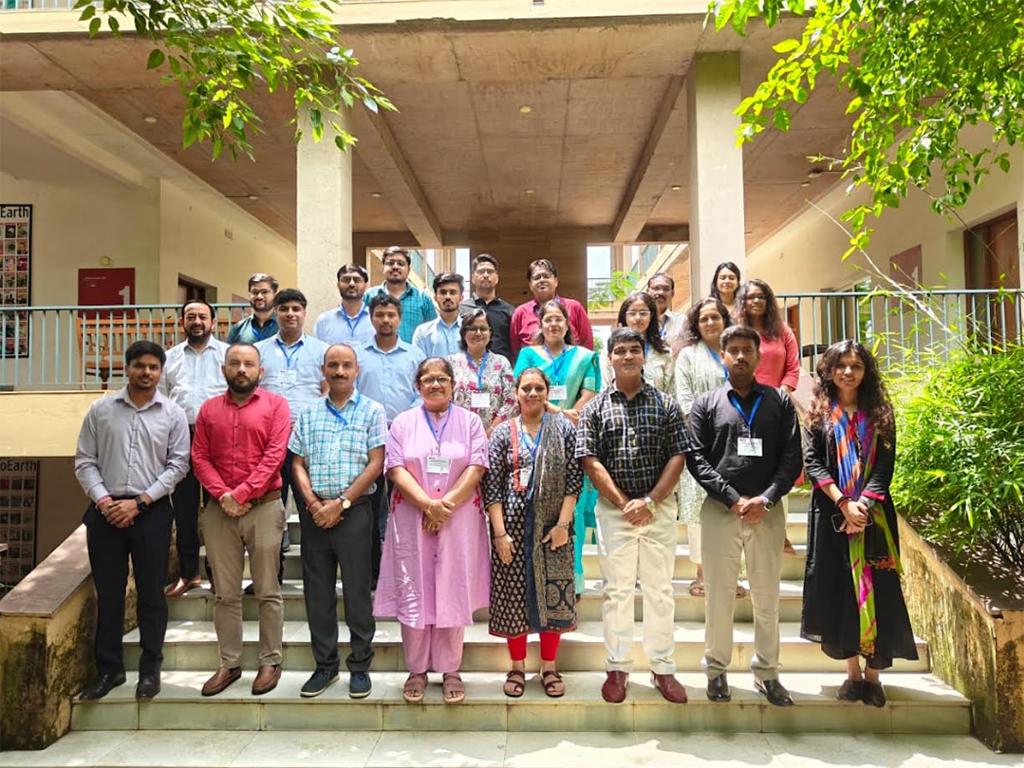
The Sustainable Habitat Programme, Centre for Science and Environment (CSE), conducted a four-day training programme on Climate-responsive Urban Centres from August 18-21, 2026. The training brought together representatives from Jammu and Kashmir, Tamil Nadu, Telangana, Bihar, Karnataka, Madhya Pradesh and Maharashtra, working with urban local bodies, planning departments, government agencies, and think tanks.
The training started with an ice-breaking session where participants shared their experiences by introducing themselves and sharing their expectations from the training. The first technical session by Mr Rajneesh Sareen, Programme Director, Sustainable Habitat, CSE, gave an overview of climate change impacts and the need for Climate Action Plans, discussed the methodologies of climate action plans and highlighted their role in building resilient cities. Ms Gauri Arora, Deputy Programme Manager, Sustainable Food Systems, took a session on the weather data collection sharing framework, where she discussed how the weather data is collected, processed, recorded and disseminated and how this framework is changing with more involvement of private agencies. Post lunch, Mr. Rajneesh Sareen took a session on GHG Protocol for cities, where he discussed the factors of city-level GHG emission assessment along with a few case studies and how to evaluate carbon footprints. This was followed by a session by Ms. Mitashi Singh, Programme Manager, Sustainable Habitat, CSE, who discussed India’s evolving climate policy landscape, covering key national policies, missions and programmes supporting climate action. The day concluded with an AAETI campus tour showcasing several green features in the campus.
Day 2 focused on understanding heat vulnerability and exploring strategies to enhance thermal comfort and improve microclimates. The day began with a session by Ms. Mitashi Singh on heat vulnerability assessment, where participants were introduced to approaches for understanding and assessing heat-related risks in urban areas. This was followed by a session by Mr. Sugeet Grover, Programme Manager, Sustainable Habitat, CSE on Energy Conservation and Sustainability Building Code (ECSBS) 2024 and Eco-Niwas Samhita 2024. The session provided an overview of both the existing and newly introduced compliance requirements. Unlike the earlier versions, which largely focused on energy efficiency, the updated codes comprises a broader sustainability approach, addressing aspects such as shading of open spaces, cool roofs provisions, topsoil conservation and measures to reduce urban heat island effect.Participants then engaged in a cool roof quiz, taken by Ms. Nida Maryam, Consultant, Sustainable Habitat, CSE, to strengthen their understanding of cool roof strategies and their contribution to reducing heat gain.The session later continued with Mr. Sugeet Grover discussing the contributors and mitigators of heat in the outdoor environment, focusing on the factors that influence urban heat and potential interventions to improve outdoor thermal conditions.The post-lunch session was a hands-on exercise on strategies for microclimate enhancement using simulations using Envimet software by Ms. Nida Maryam and Mr. Sugeet Grover. The exercise provided participants with an opportunity to explore simulation-based approaches for understanding and enhancing urban microclimates.
Day 3 began with a discussion of the simulation outputs of the participants from the previous day. This was followed by a session on low-carbon cooling systems by Mr. Sugeet Grover, where participants were introduced to the adoption of sustainable cooling solutions, including both active and passive measures. This was demonstrated by distinct design strategies.
The next session, led by Ms. Sayani Sen, Programme Officer, Sustainable Habitat, CSE, focused on flood vulnerability assessment, introducing participants to approaches for understanding and assessing flood-related climate risks. This was followed by a hands-on session on mapping climate hazards and risks, covering land surface temperature (LST), Normalised Difference Vegetation Index (NDVI) and Normalised Difference Water Index (NDWI), enabling them to assess environmental conditions and climate-related risks.
The final day began with a session by Mr Sugeet Grover on the thermal properties of materials, in which he showcased alternative materials that help reduce energy use in buildings.This was followed by a session on low-carbon construction, discussing the need for sustainable choices in building design using various technologies. The programme concluded with an online session by Ms. Mitashi Singh on operationalising climate action and budget tagging, who provided an overview of India’s climate policy framework, highlighting key national policies, missions, and programmes that are driving and supporting climate action.The training concluded with a closing ceremony, certificate distribution and feedback session, where participants reflected on their learning and experiences during the four-day programme.
Share this article