
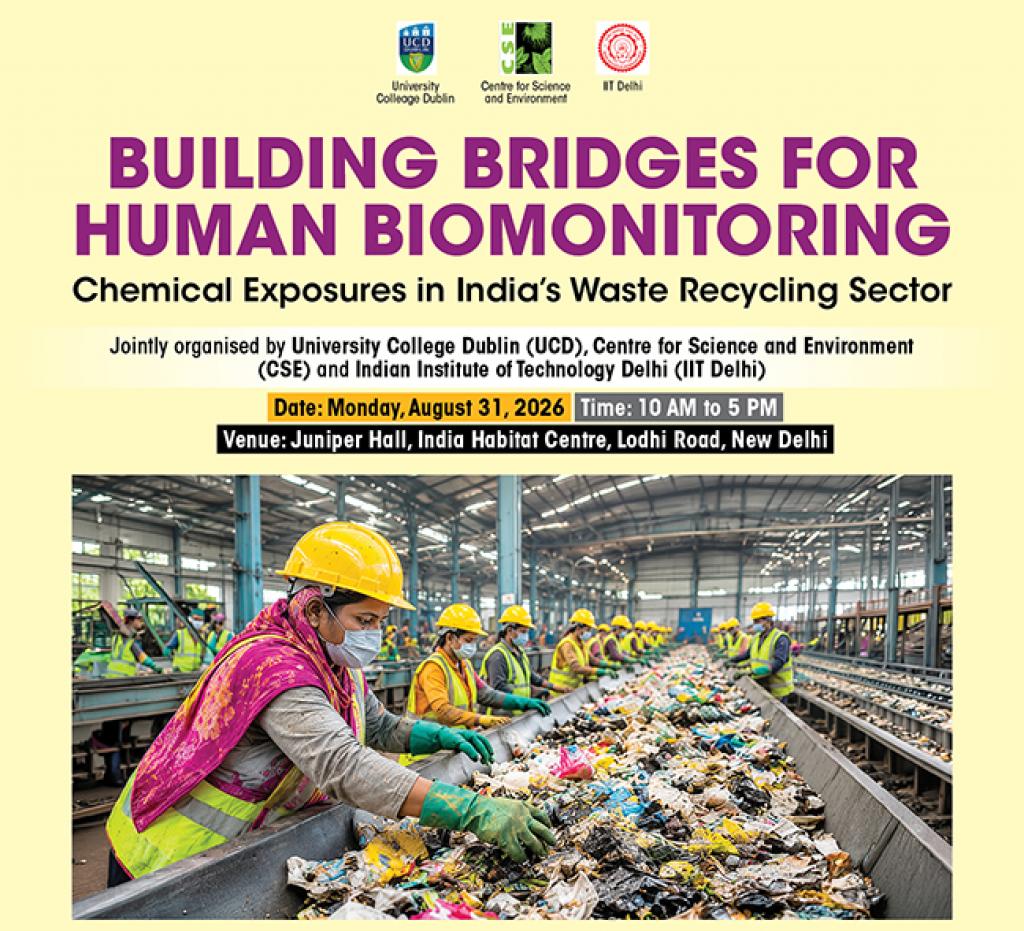
Waste workers play a vital role in India’s waste management and recycling systems. But exposed to a variety of toxic elements and pollutants in the course of their work, they are often forced to operate with limited protective equipment and minimal health monitoring. Besides frontline waste workers, local communities living in close proximity to processing, disposal and recycling sites are also affected..
Characterisation of chemical exposure from plastics, heavy metals, flame retardants and industrial residues is a critical step towards ameliorating their condition – however, this remains incomplete in India. Human Biomonitoring (HBM) is a scientific approach that measures chemicals and their metabolites in blood, urine and other biological samples, providing clear evidence of what people absorb from their work and environment. This data can inform regulation and targeted occupational health policies and could contribute to national biomonitoring efforts led by the National Centre for Disease Control under the Union Ministry of Health and Family Welfare (MoHFW).
This one-day workshop, co-hosted by University College Dublin (UCD), Centre for Science and Environment (CSE) and IIT Delhi, places Human Biomonitoring at the centre of discussions on chemical exposures in India’s waste sector. It brings together experience from Ireland’s HBM4IE programme, Germany’s national biomonitoring programme, and EU frameworks, alongside Indian expertise in policy and exposure science.
Participants will exchange knowledge and begin mapping what a sector-specific HBM pilot in India could look like and the practical steps needed to advance it.
What the workshop offers:
• Learnings from researchers behind Ireland's first national Human Biomonitoring campaign, and from leading HBM scientists from Germany.
• Opinions, information and learnings from Indian policymakers and experts on the practical realities of chemical safety and occupational health in India's waste and recycling sector.
• A hands-on World Café session shaping real research priorities and policy directions where the participants’ inputs will feed directly into a joint policy brief and workshop report.
• Lasting connections across a growing UCD-CSE-IIT Delhi research partnership, with future joint funding, publications and collaboration on the horizon.
The workshop is open for:
• Policymakers, regulators, and public health officials involved in chemical safety, environmental protection, occupational health, waste management, and public health policy.
• Representatives from government agencies, research institutions, and non-governmental organisations working on chemicals management, sustainability, waste recycling and environmental health.
• Professionals working at the intersection of waste management, circular economy, sustainability, environmental protection, and human health.
• Anyone interested in advancing research, policy, and practice related to human biomonitoring, chemical exposure, waste management and environmental health.
For more details, please contact:
Dr Anjali Nair
Programme Officer
Solid Waste Management and Circular Economy
Centre for Science and Environment (CSE)
Email:anjali.nair@cseindia.org
Mobile - 88604 24173
| Inagugural | |
| International Perspectives | |
| Panel Discussion | |
Share this article