
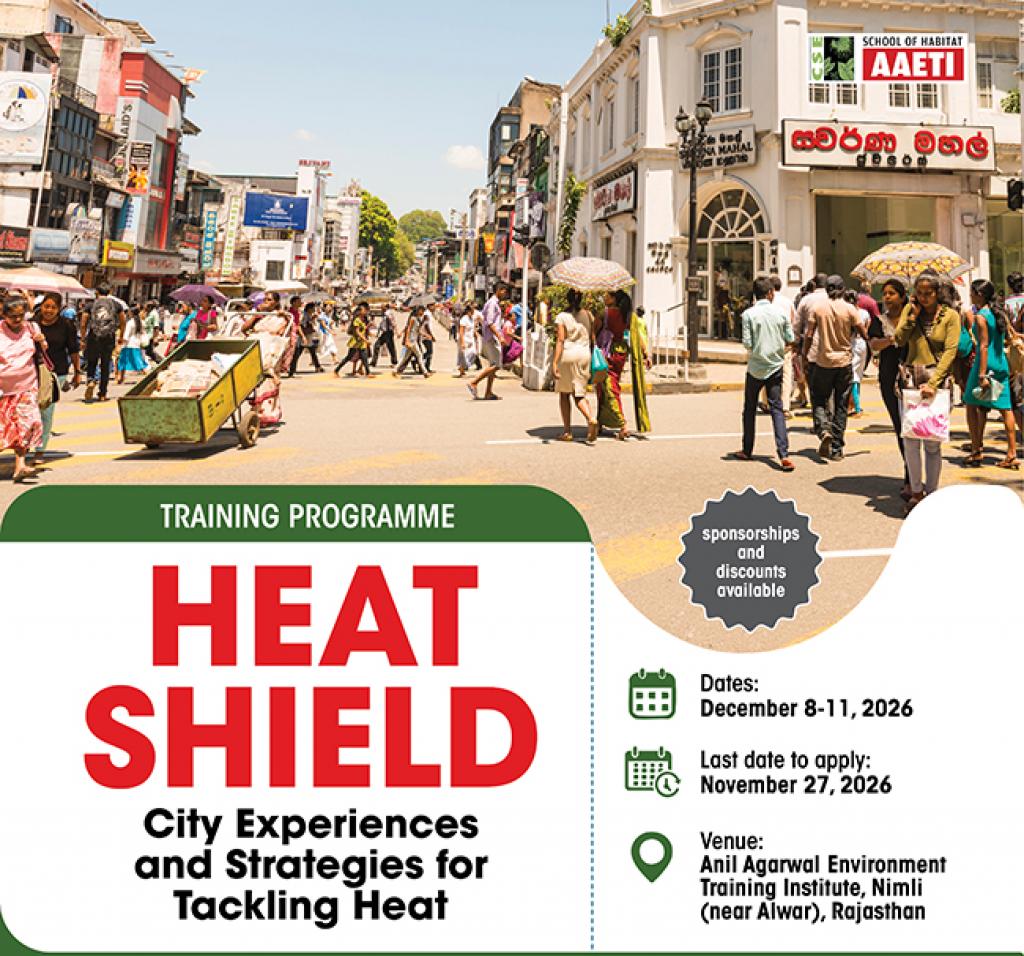
Cities are planning measures to adapt to and mitigate the impacts of urban heat. To support these efforts, the Ministry of Housing and Urban Affairs (MoHUA), under AMRUT 2.0, has launched the ‘Building Heat Resilient Cities: A Strategic Pilot for Urban India’. The programme aims to help cities identify and address urban heat risks, with particular attention to areas and communities most vulnerable to heat. Under the programme, 12 cities are receiving funding to implement pilot projects, for which they are exploring innovative solutions.
These efforts offer valuable opportunities for learning. Some cities have made note-worthy progress, with measures ranging from city-level interventions such as expanding blue-green infrastructure and providing shade, to building-level solutions including cool roofs, appropriate building materials and heat-resilient improvements in informal housing.
However, the experience of planning and implementing these interventions has brought to light gaps in ULBs’ capacity to develop baselines, assess heat risks, identify priority interventions and mobilise funding for implementation.
Centre for Science and Environment (CSE) has announced a training programme which aims to facilitate cross-learning from cities’ experiences while strengthening the capacity of city officials in heat-risk assessment, baseline development, identification of priority actions, understanding fiscal instruments, and monitoring and evaluation. It will also facilitate the co-development of a heat action roadmap, drawing on city experiences, expert insights and the perspectives of vulnerable communities to help cities become more heat-resilient.
Salient features
Course Coordinator:
Nida Maryam
Sustainable Habitat Programme, CSE
9360316439, nida.maryam@cseindia.org
Course Director:
Rajneesh Sareen
Programme Director,
Sustainable Habitat Programme, CSE,
rajneesh.sareen@cseindia.org
| Flyer | |
|
|
| Download flyer | |
| Course fee | |
| Rs 32,000 (sponsorships and discounts available)* *Course fee includes tuition fee, external expert lecture sessions, training materials, boarding and lodging, and transport from Delhi to AAETI and back. |
|
| Anil Agarwal Environment Training Institute | |
 |
|
| Download here | Download here |
| Route Map for AAETI, Neemli, Rajasthan | |
| Weather in Nimli, Tijara, Rajasthan | |
Share this article