
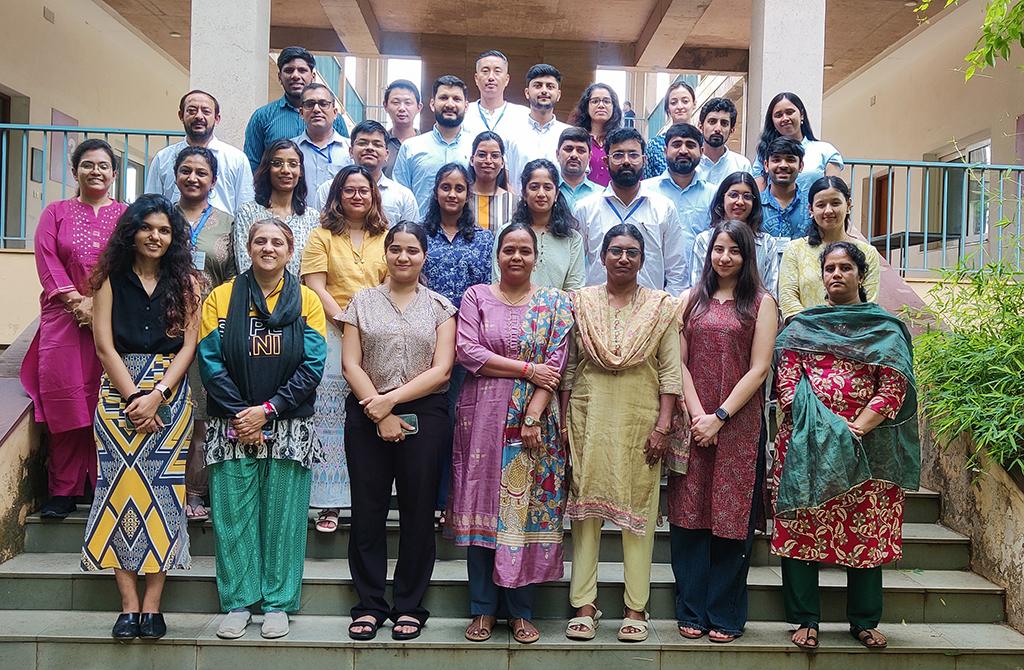
The Sustainable Habitat Programme, Centre for Science and Environment (CSE), conducted a four-day training programme on Planning and Implementation of Climate Action Plans in Cities from July 7-10, 2026. The programme brought together 27 participants from Gujarat, Rajasthan, Andhra Pradesh, Nagaland, Karnataka, Punjab, Tamil Nadu, and Maharashtra, representing climate cells, government departments, ULBs, development organisations, academic institutions and think tanks.
The training commenced with an ice-breaking session where participants shared their experiences by introducing themselves and assessed their understanding of the elements of climate action plans. The first technical session by Mr. Rajneesh Sareen, Programme Director, Sustainable Habitat, CSE, provided an overview of climate change impacts and the need for Climate Action Plans, highlighting their role in building resilient cities. This was followed by the session by Ms. Mitashi Singh, Programme Manager, Sustainable Habitat, CSE, who discussed India’s evolving climate policy landscape, covering key national policies, missions and programmes supporting climate action. The following session was taken by Dr. Pankaj Upadhyaya, DST Centre of Excellence for Climate Information at IIT Delhi, who spoke about climate trends and projections. In this session, participants were introduced to climate datasets and future climate scenarios for evidence-based planning. Post-lunch, participants were introduced to the concept of climate baselines, helping them understand the steps in preparing climate action plans. This was followed by a group exercise on preparing city climate baselines using actual datasets. The participants were asked to work in groups to conduct the sector-wise baseline assessment.
Day two started with a sessionby Mr Rajneesh Sareen, who discussed conducting vulnerability assessment and developing strategic frameworks for long-term climate mitigation through the example of heat and urban cooling. Participants then undertook a hands-on session on hazard and risk mapping. The session, conducted by Ms. Sayani Sen, Programme Officer, Sustainable Habitat, CSE, introduced participants to the use of GIS for calculating key geospatial indicators, including the Normalised Burn Ratio (NBR), Land Surface Temperature (LST), Normalised Difference Vegetation Index (NDVI) and Normalised Difference Water Index (NDWI), enabling them to assess environmental conditions and climate-related risks.The day concluded with an AAETI campus tour showcasing sustainable infrastructure and resource-efficient design features.
The third day began with an online session by Ms. Kalyani Tembhe, Programme Manager, Air Pollution Control, CSE, introducing greenhouse gas emissions modelling methodologies and their application in city-level climate planning across different sectors. Subsequent sessions by Ms. Sayani Sen and Ms. Mitashi Singh, respectively, focused on flood vulnerability, heat vulnerability, and developing a framework for operationalising Climate Action Plans. The day concluded with interactive exercises on identifying adaptation and mitigation strategies, developing performance indicators, and assessing programmatic and fiscal gaps required for effective implementation.
The final day of the training focused on finding financing options for climate actions. Mr. Sarath Babu, Manager, Climate Policy Initiative, delivered a session on climate finance and funding opportunities, discussing national and international financing mechanisms, innovative funding instruments, and strategies for mobilising investments to support climate action. Following this session, participantsworked on integrating climate budgeting and financing opportunities into city planning processes to facilitate implementation as a part of their ongoing exercise.Participants then presented their final group exercises, which they had progressively developed and refined throughout the training by incorporating the concepts covered in each technical session based on the learnings and feedback received throughout. The programme concluded with a closing ceremony and certificate distribution.
During the training, some participants showcased the projects they are currently engaged in, creating an opportunity for discussions and cross-learning among other participants.Overall, the training combined expert lectures, interactive discussions, and practical exercises to strengthen participants' capacities in preparing and implementing Climate Action Plans. By integrating climate action plan elements - baselines, vulnerability assessment, greenhouse gas emissions, adaptation and mitigation planning, implementation frameworks, and climate finance- the programme equipped officials with practical tools to develop evidence-based, actionable, and finance-ready climate strategies for cities.
Share this article