
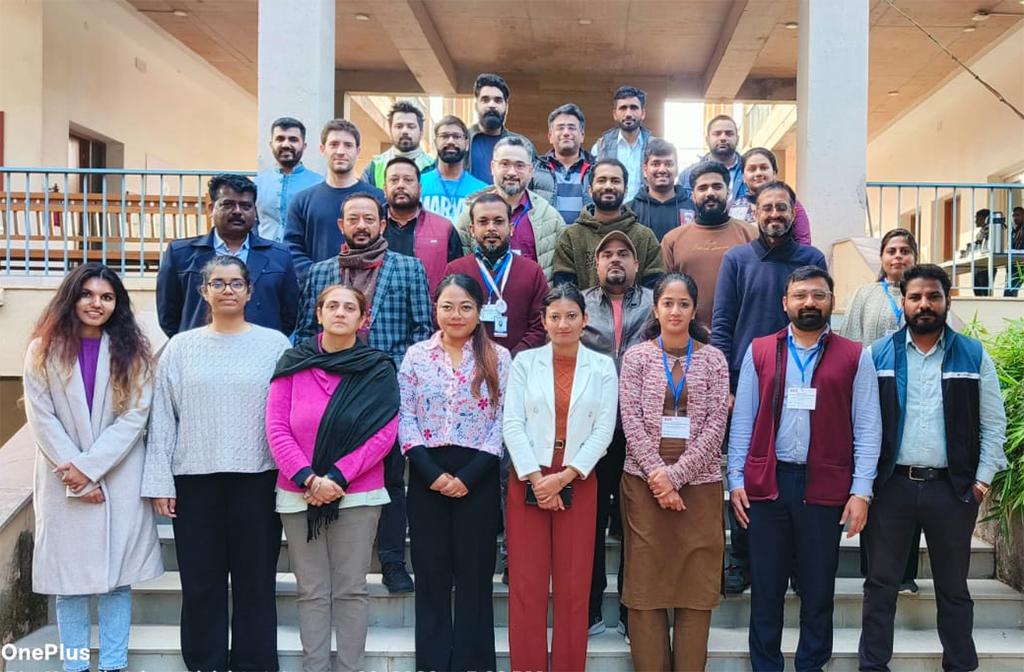
A residential training programme on Heat-proof Cities: Pathways for Sustainable Cooling and Heat Mitigation was organised by the Sustainable Habitat team at the Centre for Science and Environment (CSE). The programme was held from January 27–30, 2026, at the Anil Agarwal Environment Training Institute (AAETI), Tijara. It was attended by officials from planning departments of multiple states, municipal officials, representatives from environmental institutions, academicians, and researchers. In total, 24 participants attended the four-day training programme. This diverse group brought valuable insights from their respective fields, enriching discussions on climate impacts, risks, and strategies being adopted across urban areas.
The programme began with Mr. Sugeet Grover, Programme Manager, CSE, introducing participants to the urgent need for large-scale adoption of sustainable cooling measures and the solutions available in the market. He supported this with examples of four buildings from different eras and how each addressed the challenges of its time using different approaches. This was followed by a tour of the India Habitat Centre in Delhi. Participants were then taken on a field visit to the Sehgal Foundation building in Gurugram, where they observed sustainable and passive design features in practice and gained insights into how integrated architectural strategies can enhance thermal comfort and reduce energy demand.
The second day began with an ice-breaking session to help participants get to know each other better. The first technical session was led by Mr. Rajneesh Sareen, Programme Director, Sustainable Habitat Programme, who presented the Cooling Master Plan framework. He detailed pathways to reduce cooling demand through energy-efficient buildings, renewable energy integration, and district cooling systems. The next session, conducted by Ms. Mitashi Singh, Programme Manager, CSE, focused on CSE’s recent work on developing methodologies to assess heat vulnerability. In the second half of the day, Mr. Sugeet Grover covered the drivers influencing urban heat dynamics, examining both factors that increase and reduce heat, as well as urban sources and sinks. The session focused on three key aspects: urban cover, urban structure, and urban metabolism. This was followed by a session by Mr. Rajneesh Sareen, who extended these concepts to the neighbourhood level by discussing principles of microclimate enhancement, including how materials, vegetation, and water bodies shape local conditions.
The third day commenced with Mr. Rajneesh Sareen on the Energy Conservation and Sustainability Building Code (ECSBC) 2024 and Eco-Niwas Samhita (ENS) 2024. While earlier versions of these codes focused primarily on energy efficiency, the latest versions incorporate multiple aspects of sustainability, including shading of open areas, cool roof requirements, topsoil conservation, and mitigation of the urban heat island effect. Both existing and new compliance measures were explained in detail. Ms. Sayani Sen then conducted hands-on exercises on mapping heat-stressed areas and heat sinks using satellite imagery and indicators such as LST, NDVI, and NDWI. These exercises demonstrated how spatial mapping can support climate adaptation and urban cooling strategies. The day concluded with a tour of the AAETI campus, highlighting its green features.
On the final day, participants were introduced to a methodology to estimate the solar potential of a city as well at the household scale. This was followed by a practical demonstration of the solar and mechanical systems installed at the AAETI campus. The next session focused on pathways to reduce carbon emissions in the built environment and promote sustainable construction practices. Mr. Sugeet Grover conducted a session on Low-Carbon construction Materials. He showcased alternative materials and construction technologies that help reduce both embodied and operational energy in buildings.
Share this article