
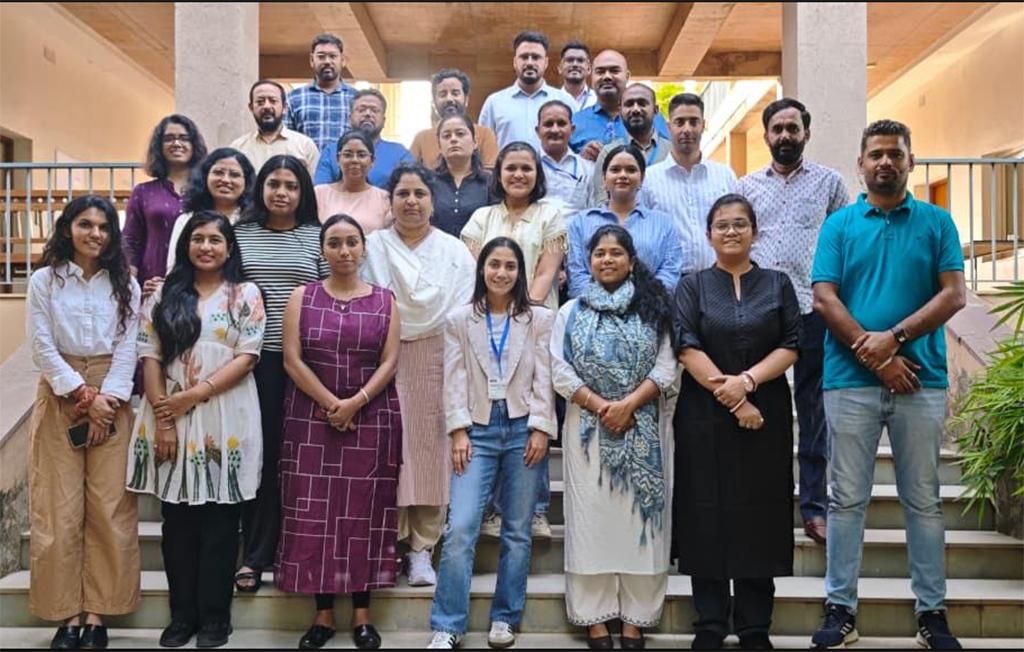
The Sustainable Habitat Programme, Centre for Science and Environment (CSE), conducted a four-day training programme on Decarbonising Cities: A whole-carbon approach for low-carbon and energy-efficient development from October 6-9, 2026, at the Anil Agarwal Environment Training Institute (AAETI) in Nimli, Rajasthan. The training brought together participants from Jammu and Kashmir, Telangana, Madhya Pradesh, Rajasthan, Meghalaya and Telangana representing urban Local bodies, state planning departments, state environment departments, government agencies and think tanks.
The training started with an ice-breaking session where participants introduced themselves and shared their expectations from the training. The first technical session by Mr Rajneesh Sareen, Programme Director, Sustainable Habitat, CSE, gave an overview of thecomplete course by breaking down the whole-carbon approach to be covered in the programme. This includes outdoor heat management,thermal comfort in buildings, low-carbon cooling systems, use of sustainable materials like recycled construction and demolition (C&D) waste and GHG emissions accounting. Ms. Mitashi Singh, Programme Manager, Sustainable Habitat, CSE, then discussed India’s evolving climate policy landscape, covering key national targets, missions and programmes supporting climate action. Post lunch, Ms. Sayani Sen, Programme Officer, Sustainable Habitat, CSE, led a hands-on exercise on mapping climate hazards and risks using Land Surface Temperature (LST),NDVI, and NDWI. Mr. Rajneesh Sareen then discussed measures to mitigate outdoor heat as a crucial decarbonization and adaptation need, helping participants understand the scope and depth of the subject.
Day two started with a session by Mr Rajneesh Sareen, who discussed an urban cooling framework that enables planning and implementing low-carbon pathways for a city with an emphasis on cooling energy and alternative solutions for cooling. This was followed by a session by Ms. Sayani Sen, who elaborated a methodology of developing an urban cooling framework. This included cooling energy demand projections, establishing alternative energy potential, and identifying feasible cooling solutions by integrating alternative energy and technology. This was followed by a session on calculating solar rooftop energy generation potential.A session on C&D waste management including the new rules and best practices was taken by Ms. Mitashi Singh.Post lunch, Ms. Mitashi Singh took a session on operationalising climate action and budget tagging by linking of climate strategies and performance indicators with ongoing programmes, statutory budget and innovative climate finance strategies. The afternoon continued with a session on low-carbon cooling systems by Mr. Rajneesh Sareen, where participants were introduced with use of both active and passive measures for cooling through several case studies. This was followed by a session by Mr. Rajneesh Sareen on GHG Protocol for cities, where he discussed the principles of city-level GHG emissions accounting along with a few case studies and how to evaluate carbon footprints. The day concluded with an AAETI campus tour showcasing several green features in the campus.
Day three opened with an online session on developing an embodied carbon baseline for Indian buildingsby guest expert Ms. Saswati Chetia, Director, Greentech Knowledge Solutions Pvt. Ltd.The session explored the concept of whole-life carbon across a building’s lifecycle, covering embodied and operational emissions, lifecycle assessment standards, and methodologies for measuring embodied carbon.Ms. Sayani Sen then led a session on understanding value and the trade chain of the construction materials and C&D waste within and outside the cityto understand the embodied carbon involved.Next, Mr. Sugeet Grover, Programme Manager, Sustainable Habitat, CSE, explored decarbonisation strategies in buildings and discussed understanding thermal comfort across indoor and outdoor environments.Participants then engaged in a cool roof quizto strengthen their understanding of cool roof strategies and their contribution to reducing heat gain.The post-lunch session was a hands-on exercise on strategies for microclimate enhancement using simulations using Envimet software by Ms. Nida Maryam, Sustainable Habitat, CSE and Mr. Sugeet Grover. The exercise provided participants with an understanding on surface finishes and properties that contribute to heat trapping and release to inform decisions on urban microclimate management.
The final day introduced participants to the thermal properties of materials, in a session by Mr. Sugeet Grover.He presented alternative materials that can help minimise energy consumption in buildings. He also discussed the latest Energy Conservation Building Codes, which in contrast to the earlier versions, adopt a more comprehensive approach to sustainability, covering aspects such as shading of open spaces, cool roof provisions, topsoil conservation, and strategies to mitigate the urban heat island effect. The four-day programme concluded with a closing ceremony, a feedback session, and the distribution of certificates.
Share this article