
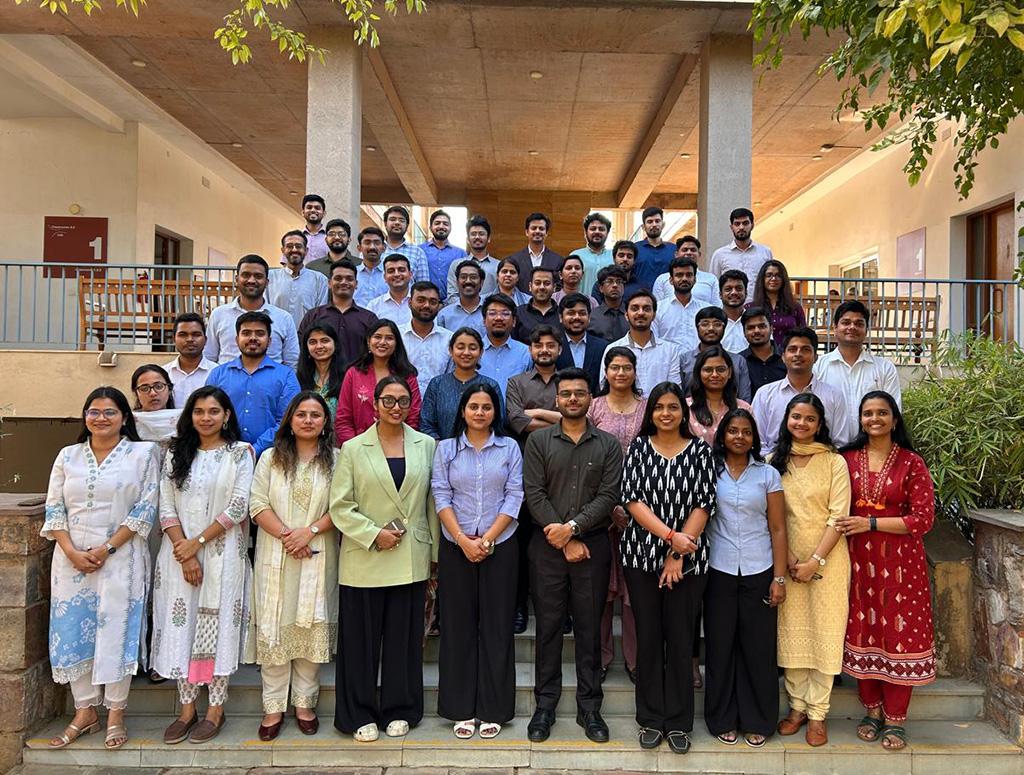
The Sustainable Habitat Programme, Centre for Science and Environment (CSE), conducted a three-day training programme on Sustainable Building Design Processes from March 23–25, 2026. The programme brought together 50 government officials at the Anil Agarwal Environment Training Institute (AAETI), Neemli, Rajasthan.
The training began with an ice-breaking session where participants shared expectations and assessed their understanding of sustainable building design. The technical sessions commenced with Ms. Mitashi Singh, who conducted a session on outdoor thermal comfort, highlighting the impacts of climate change and the growing risks posed by rising temperatures in urban habitats. She also introduced the concept of heat vulnerability assessment, explaining how the loss of natural features and the expansion of built-up areas and anthropogenetic activities are intensifying heat stress in cities. This was followed by a session by Mr. Sugeet Grover on the drivers of heat gain and mitigation strategies. He discussed how factors such as urban morphology, building aspect ratio, and orientation influence heat trapping in cities, and outlined key measures including expanding blue-green infrastructure and integrating shading interventions to reduce heat accumulation in urban areas. A subsequent session by Ms. Mitashi Singh focused on ecological planning, water conservation, and stormwater management as integrated strategies to address both urban heat and flood vulnerability. This was followed by a session by Mr. Sugeet Grover on climate-responsive design and thermal comfort. The session introduced participants to key analytical tools such as solar path diagrams and psychrometric charts, helping them understand the relationship between climate, building orientation, and human comfort. He explained how these tools can be used to guide design decisions, including orientation, shading, ventilation, and material selection, to reduce heat gain and improve indoor comfort. The day concluded with a tour of the AAETI campus, showcasing its sustainable design features.
Day 2 began with a session by Mr. Sugeet Grover on building envelopes and the thermal performance of materials. The session focused on the role of insulation, thermal mass, and window-to-wall ratios in controlling heat gain and improving energy efficiency. This was followed by a session on low-carbon construction technologies, which emphasized the use of materials with low embodied energy along with cyclic and renewable resources. Such technologies not only minimize the environmental footprint of construction but also enhance occupant thermal comfort. A subsequent session focused on sustainable cooling technologies based on non-refrigerant approaches, including not-in-kind cooling technologies, structural cooling techniques, district cooling systems etc. The day concluded with the introduction of a group exercise, where participants were tasked to prepare presentations on passive cooling strategies for different climatic zones.
The final day of the training began with a session by Mr. Rajneesh Sareen, Programme Director, Sustainable Habitat Programme, on Environmental Impact Assessment (EIA), emphasising the integration of impact assessment across all stages of construction. This was followed by a session on rainwater harvesting and decentralised wastewater treatment systems, which highlighted practical approaches for reducing freshwater demand and promoting water reuse across urban landuses. Post lunch, a session on the Energy Conservation and Sustainable Building Code (ECSBC) 2024 outlined key regulatory provisions aimed at improving building energy performance. The discussion also highlighted how the updated code extends beyond energy efficiency to address broader sustainability aspects, including shading of open areas, cool roof requirements, topsoil conservation, and mitigation of urban heat island effects, along with both existing and newly introduced compliance measures.The technical sessions were followed by an interactive quiz on thermally efficient cool roofs, conducted by Ms. Sayani Sen, Programme Officer, Sustainable Habitat Programme. Participants then presented their group work, sharing insights on climate-responsive design approaches across different climatic zones. The training concluded with a closing ceremony.
The training brought together technical sessions, interactive discussions, and practical learning experiences aimed at strengthening the capacity of CPWD officials in sustainable and climate-responsive building design.
Share this article