
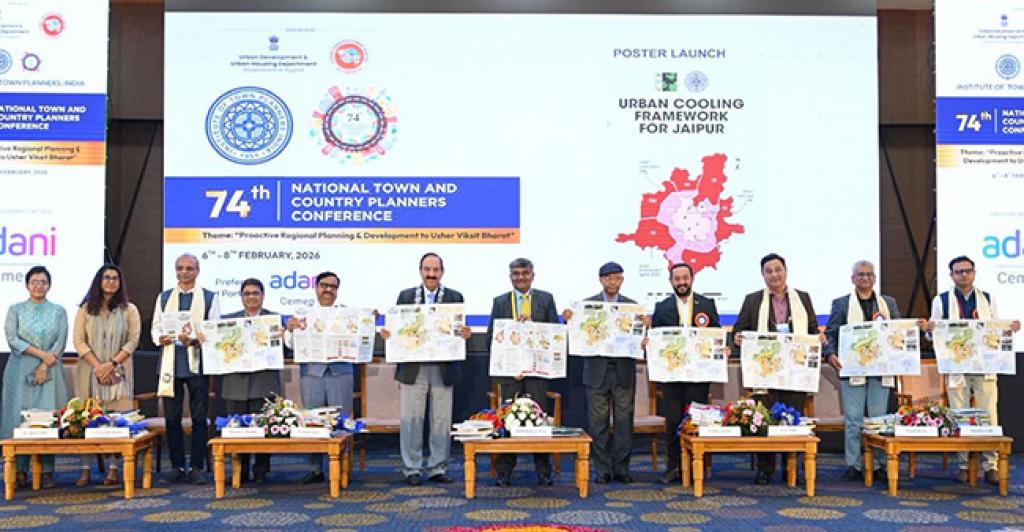
Sustainable Habitat Programme, CSE,participated in the 74th National Town and Country Planners Conference, held in Ahmedabad from February 6 to 8, 2026, as a knowledge partner along with CEPT University. Theconference engaged with over 310 planners from across the country to advance climate-responsive urban planning.
On day 1, the Programme released theUrban Cooling Framework for Jaipur Region posterin the presence of dignitaries, including Srinivas Katikithala (Secretary, MoHUA) and Keshav Verma (Chairman, High Level Committee on Urban Development, Gujarat), along with senior planning officials from Gujarat, Telangana, Uttar Pradesh, Rajasthan, and Maharashtra.
This framework provides a planning-led roadmap for sustainable and equitable cooling. Driven by heat-stress mapping and vulnerability assessments, it offers strategies to enhance energy security, cooling equity, and overall liveability while reducing air pollution and heat risks. It adds onto the CSE’s Heat Toolkit, expanding on methods to assess granular vulnerability at city and neighbourhood scales.
On day 2, the Programme conducted a technical session on Climate Literacy in Academia and Practice, which involved a panel discussion on integrating climate change mitigation, adaptation and disaster risk reduction with Bachelor’s and Master’s in planning programmes pushed by the National Education Policy 2020.
Ms. Mitashi Singh (Programme Manager, Sustainable Habitat Programme, CSE) moderated the panel discussion. The session featured insights from Mr. Rajneesh Sareen (Programme Director, Sustainable Habitat Programme, CSE), who sharedhow planning education and practice is evolving to integrate climate literacy and action. He also shared the update on the AICTE approval of eight specialised courses, along with the adoption of the revised approach by over 83 planning schools nationwide. Mr. Ashwani Luthra (Secretary, Expert Committee on NEP 2020 and Planning Education, ITPI)shared experience on how the committee pointed out that planning education had not received much update pertaining to the latest national climate goals and targets, hence needing a reform. Ms. Gayathri Aaditya (Principal, Sir MV School of Architecture, Bengaluru), shared ground experience, including how planning schools are adopting the new curricula and that it is already affecting planning practice positively.
Through these engagements, the Sustainable Habitat Programme has established a robust foundation for mainstreaming climate adaptation in urban planning with a focus on cooling infrastructure and equity solutions essential for a rapidly developing India facing a rising urban heat crisis.
Share this article