
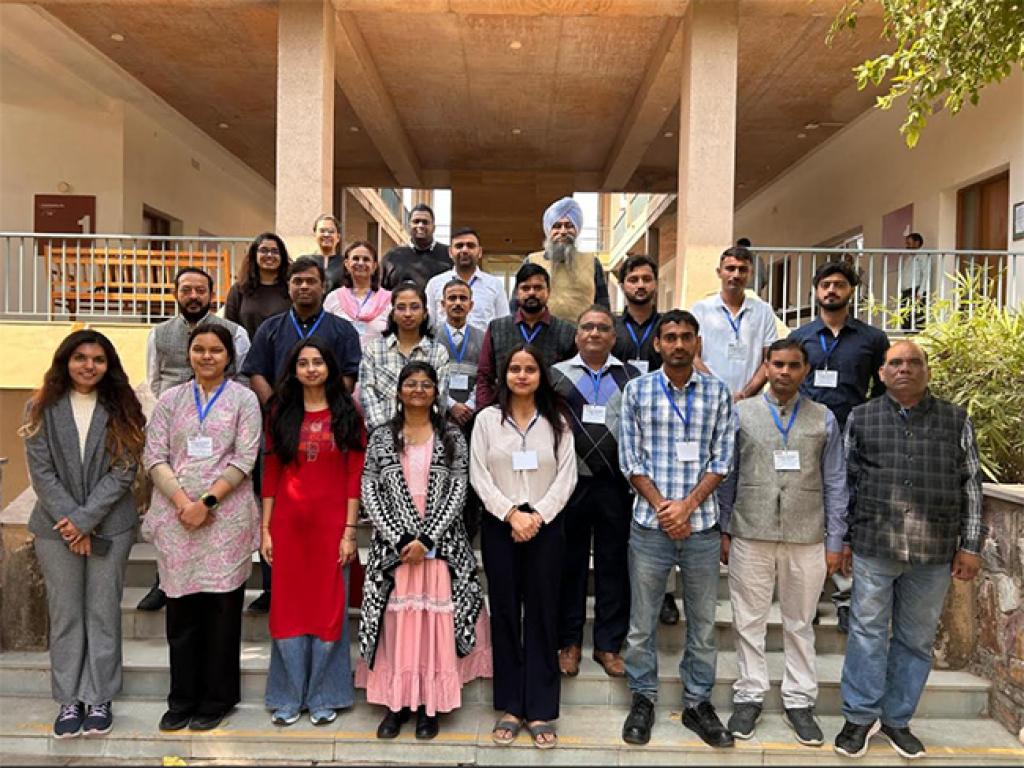
The Sustainable Habitat Programme of the Centre for Science and Environment (CSE) conducted a five-day residential training programme cum exposure visit on Circular Pathways: Focus on C&D Waste Management and Dust Control at the Anil Agarwal Environment Training Institute (AAETI), Neemli, Rajasthan, from February 16th to 20th, 2026. The programme brought together 19 participants, including representatives from urban local bodies, government construction companies, state pollution control boards, think-tanks and academia from across India. The wide range of stakeholders facilitated meaningful cross-learning on effective strategies for managing C&D waste and mitigating dust emissions.
The training began with a session by Mr Rajneesh Sareen, Programme Director, discussing the principles of circularity and resource efficiency in the built environment and by providing an overview of the training. The next day began with an ice-breaking session where participants shared their expectations while taking part in a poll assessing their understanding of C&D waste management, setting the tone for the discussions ahead. Mr Rajneesh Sareen began the classroom session on Environmental Impact Assessment (EIA) of the air environment for construction projects. This was followed by a session by Mr Danish Meena from the Central Pollution Control Board (CPCB) on Environment (Construction and Demolition) Waste Management Rules, 2025. He addressed the objectives, key stakeholders, key entities, and management framework of the Waste Management Rules.Ms Mitashi Singh, Programme Manager, commenced the next classroom session on C&D Waste Estimation Methodologies. She introduced participants to various city-level C&D waste estimation methodologies that use different data repositories.Post lunch, a session on C&D waste management ecosystems and milestones was taken by Mr. Sugeet Grover, Programme Manager. It focused on outlining comprehensive steps for establishing a C&D Waste Management ecosystem supported by case studies of multiple cities. This was followed by an exerciseled by Ms. Sayani Sen, Programme Officer, on pre-demolition volumetric assessment. This enabled participants to apply estimation techniques to practical site-level scenarios.The sessions then progressed to discussions on understanding value and the trade chain of the construction sector while examining the movement of construction materials and C&D waste within the city. This exploration aimed to uncover key challenges and opportunities within the material flow system, with particular attention to the role of the informal sector.
Day 3 focused on strengthening practical understanding of on-site dust control and C&D waste management through interactive exercises and technical inputs. The day began with an exercise by Ms. Sayani Sen on drawing a typical construction timeline to integrate C&D waste and dust management to understand the appropriate sequence of actions that require different C&D waste and dust management at a site.This was followed by a detailed session by Mr Sugeet Grover, on on-site dust management requirements, highlighting process management measures and safeguards for material handling at both site and city scales, including area and linear projects.Participants then engaged in an action-planning exercise to develop context-specific strategies for C&D waste and dust control based on ground experiences and identified gaps in cities.
In the afternoon, there was a session by Mr. Grover where participants were introduced to C&D waste processing technologies, equipment, recycled products, and plant economics, enabling them to understand the operational and financial dimensions of recycling systems. The day concluded with group presentations on identifying and documenting materials from a campus that could be reused in the event of demolition, followed by a closing ceremony and feedback session, consolidating key learnings from the training programme.
The training culminated with a conference which brought together several experts from various cities who shared their expertise, highlighting good practices from the cities as well as persistent challenges in implementation, followed by a recycling plant visit in Jaipur to showcase equipment, operations and several processes involved.
Share this article