
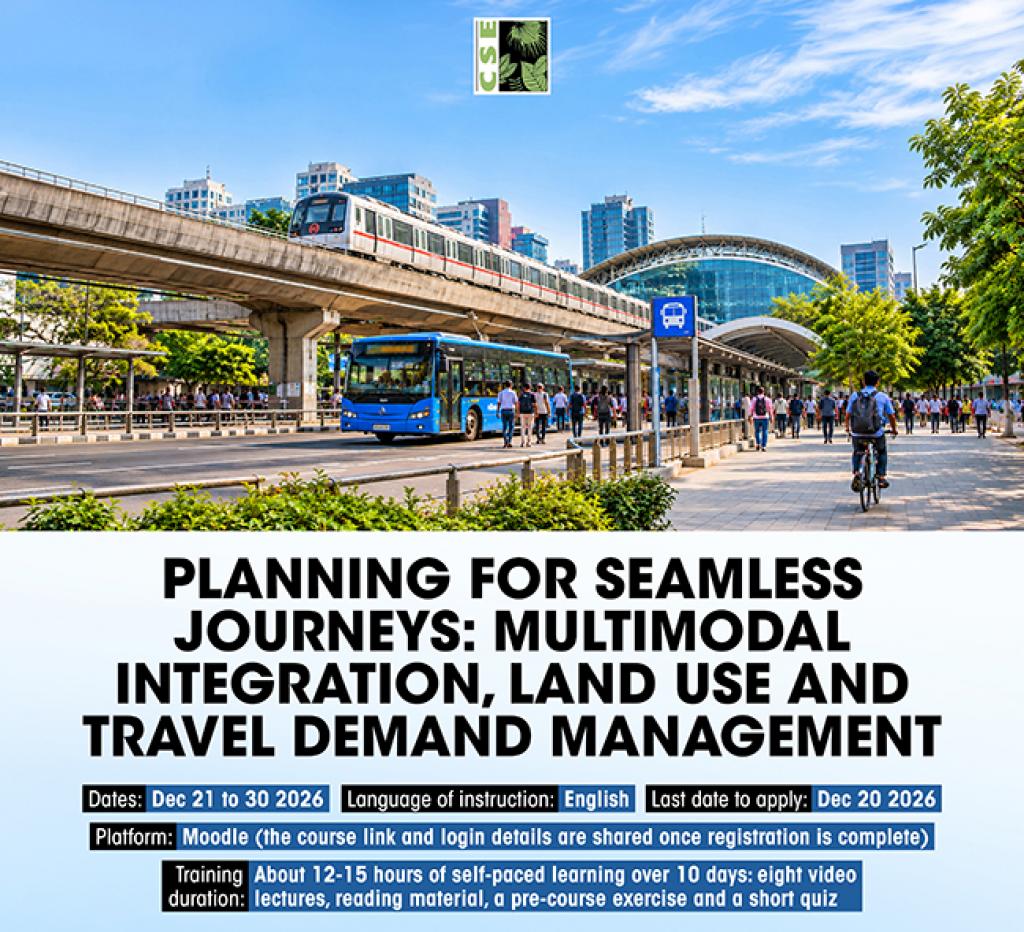
Indian cities are adding metro lines, bus fleets and feeder services, yet many commuters still find it easier to take a private vehicle. The problem is not a lack of services, rather the gaps between them: long walks between stations and bus stops, separate tickets for every leg, timetables that do not meet, and agencies that plan in isolation. Centre for Science and Environment (CSE) offers an online training course on multimodal integration (MMI), the practice of planning a city's transport as one network built around the whole journey rather than individual modes.
Over 10 days, the course takes participants through the five pillars of integration (network, physical, fare, information and institutional) and the land-use and demand management policies that support them, with examples from Indian and global cities. Sessions are led by practitioners, planners and researchers working on these questions in Indian cities.
The self-paced online programme will feature video lectures, reading material, a pre-course exercise and a short quiz. A new module opens every day, and participants can watch it at any time that suits them, at their own pace and convenience.
KEY MODULES IN THE COURSE:
For more information, please contact:
COURSE ORGANISERS
Shubham Srivastav
Deputy Programme Manager
Sustainable Mobility, CSE
Email: shubham.srivastava@cseindia.org
Sayan Roy
Programme Manager
Sustainable Mobility, CSE
Email: sayan.roy@cseindia.org
| Flyer | |
|
|
| Download flyer | |
| Course fee | |
| ₹1,500 (Indian participants); USD 30 (global participants)
|
|
| Who can apply? | |
|
|
| Certificate | |
| Participants will be awarded a certificate of participation on completion of the course |
Share this article