
Sustainable Habitat Programme organised a regional conference on “Interpreting Good Practices to Drive Clean Air Action under the National Clean Air Programme (NCAP)” in Jaipur on March 14, 2026. The conference brought together policymakers, state implementing agencies, practitioners, industry representatives and researchers to exchange experiences, highlight innovative technical, planning and financial approaches.
Centre for Science and Environment (CSE) has been closely working with various non-attainment cities across Rajasthan to plan and implement multi-sectoral clean air action and its implementation. Sustainable Habitat Team has been providing support to non-attainment cities and SMB 2.0 cities to help design their Construction and Demolition (C&D) waste ecosystems. This regional conference served as a critical culmination of those ongoing efforts, bringing together key stakeholders to consolidate progress and chart a roadmap for the new regulatory framework.
The inaugural session began with Mr. Rajneesh Sareen, Director, Sustainable Habitat Programme, CSE, who delivered the opening remarks, highlighting work and partnership with the Rajasthan Government in advancing multi-sectoral clean air action. Setting the agenda, Ms. Anumita Roychowdhury, Executive Director, Research and Advocacy, CSE, discussed lessons from good practices across India. This involves multi-sector solutions like zero emission transport mandates, clean fuel transition in industries, and waste circularity through biomethanation, recycling and reusing to achieve air quality targets under NCAP.
Mr. Vijai N, Secretary (IFS), discussed varying urban ecosystems and the need for targeted interventions to address dust pollution. Prof. Rajeev Shringi, Head, Department of Architecture & Planning, MNIT, highlighted the integration of clean air strategies into planning practice and education.
Mr. Pradeep Kapoor, President, ITPI, noted the deteriorating air quality in Rajasthan and called for comprehensive action, including research, planning transformation, behavioural change and public awareness. Mr. Shashikant, CTP, Rajasthan, shared measures such as cleaner streets and increased greenery, while Mr. Ravi Rai Verma, CTP (NCR), Rajasthan, emphasised the importance of protecting and enhancing the Aravallis in NCR towns of Rajasthan for long-term climate co-benefits.
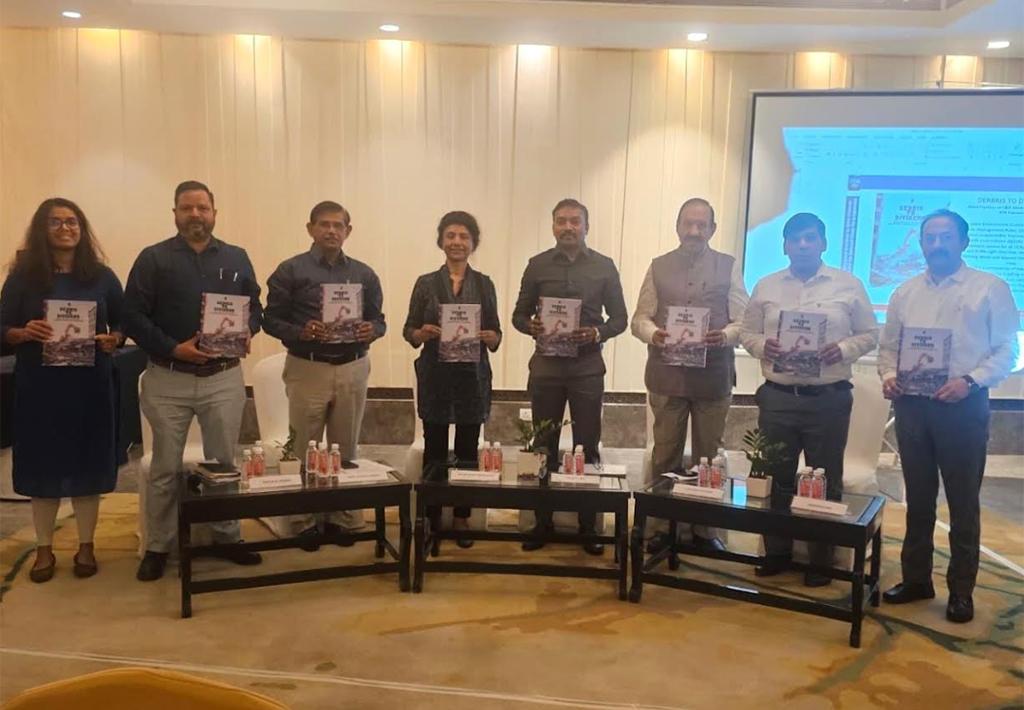
During the session, CSE also released its report, “Debris to Dividend”, along with the dignitaries. The report highlights key practices adopted by certain cities that are already performing beyond the requirements of the latest Environment (Construction and Demolition) Waste Management Rules, 2025.These rules introduce an extended producer responsibility framework for large generators, along with a centralised, digitally tracked monitoring and enforcement system for all ULBs. It also identifies critical factors that will influence the success of these rules and the advancement of material circularity in India.
Ms. Mitashi Singh, Programme Manager, Sustainable Habitat Programme, moderated the technical session on C&D waste management, which began with Mr. Danish Meena (CPCB), who outlined the legislative and compliance frameworks under the Environment (C&D) Waste Management Rules, 2025, along with stakeholder responsibilities. This was followed by city-level insights, including Mr. Pradeep Khandelwal’s review of the development and progress of Delhi’s C&D waste facilities, and Dr. Sandeep Shrivastava’s (MNIT) overview of Jaipur’s waste scenario, including testing and standards for reuse. The session concluded with Mr. Mukesh Dhiman, who highlighted operational aspects such as monitoring protocols, dust management and environmental compliance at the Noida plant.
The conference concluded with an open discussion among participants, highlighting the importance of cross-sectoral coordination, innovation and cohesive ecosystems for circularity and clean air in Rajasthan.
Share this article