
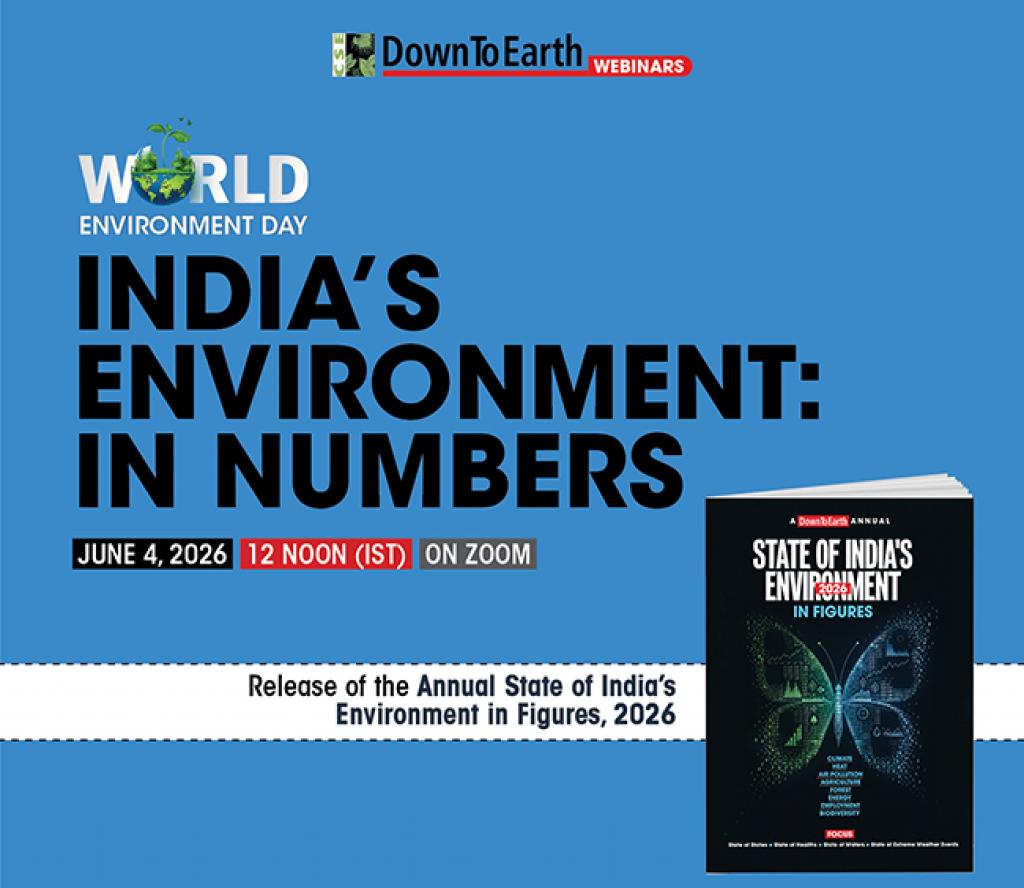
State of India’s Environment 2026: In Figuresuses official government data sources to compile, analyse and present cutting-edge information on topics ranging from climate, extreme weather events, heat and internal displacement of communities and populations, to water, air, waste, forests and the ‘state of the states’
New Delhi, June 4, 2026: “We must hold on to numbers. I have been saying this because you get what you measure; more importantly,what gets measured is what, subsequently, gets done. Data, therefore, is central to driving actions,” writes Sunita Narain, director general of Centre for Science and Environment (CSE) in the foreword of a report that she released here today. The report -- The State of India’s Environment 2026: In Figures-- is a unique annual e-compilation of data and statistics on environment and development in India, published by Down To Earth magazine and CSE.
Using official government data sources, the compilation covers topics ranging from climate, extreme weather events, heat and internal displacement of communities and populations, to water, air, waste and forests. It also includes a comprehensive ‘state of the states’ (see additional press release on this) section.
What the report says
Forests and biodiversity: Between 2020-21 and 2024-25, India’s environment ministry approved diversion of around 97,000 hectare(ha) of forestland for non-forest uses. During this period, forest diversion increased in 26 states. Incidents of elephant and tiger attacks on humans are also on the rise -- between 2020-21 and 2024-25, elephant attacks on humans increased in 10 states. Tigers killed 40 people in the first six months of 2025 alone.
Environmental crimes: Though environmental crimes declined in 2024 compared with the previous year, more than 99,000 environmental cases were still pending before the courts at year-end.
Water: The United Nations University Institute for Water, Environment and Health has warned that the planet has entered what it calls the “Global Water Bankruptcy” era. In many areas of the world, rivers, lakes, aquifers, wetlands, soils and glaciers have been damaged beyond realistic prospects of full recovery. India’s major river deltas are sinking at alarming rates due to excessive groundwater extraction. Fifteen states and Union territories are reported to have over-exploited their groundwater -- Punjab, Rajasthan and Haryana extract more groundwater than what gets recharged.
Public health: Nearly 13 per cent of Indians suffer from some kind of disease, the report quotes the Household Social Consumption: Healthpaper released by the National Statistical Office in April 2026. Young girls and women are reporting more illness than men in both rural and urban areas. The share of people reporting illness has doubled in three decades. Heart diseases are striking early in India and have emerged as the country’s biggest health burden. Among Indians aged 15-29 years, cardiovascular diseases account for about 2 per cent of the reported ailments. Illness has also been linked to more than 30,600 deaths by suicide.
Extreme weather: All states and UTs reported extreme weather events in 2025. According to Kiran Pandey, programme director, environmental resources CSE: “This analysis has been extracted based on the CSE-Down To Earth database on extreme weather, which has been in operation since 2022. Nation-wide, extreme weather events were recorded on 99 per cent days of the year. These events killed 4,421 people and damaged 17.41 million ha of cropped areas.”
She adds that alongside monsoons, pre- and post-monsoon seasons are now emerging as the most devastating periods, recording more rainfall and floods than before. March and April have become critical risk months for Indian farmers, with hotter, wetter conditions and expanding hailstorm belts. Wide temperature anomalies have also been recorded in winter, with clear signs of warming. For the first time, February 2026 did not record any cold wave – the hill state of Himachal Pradesh experienced a severe heatwave in early March 2026.
Air pollution and mobility: Health burden of air pollution in India is increasing, leading to respiratory illnesses, heart diseases, strokes, weakened immunity, and long-term impacts on children and the elderly. The country’s share of global air pollution-related deaths rose from 23.76 per cent to 25.34 per cent between 2014 and 2023. In 2023, India’s air pollution-related death rate was 186 per 100,000 people, while the global average was 114. Deaths attributable to ambient PM2.5 in India have also increased by 61 per cent in the past decade. Household air pollution deaths have, however, seen a fall of over 22 per cent, indicating benefits of the switch to clean cooking fuels.
For more such information, order your e-copy of the report here
Says Richard Mahapatra, managing editor of Down To Earth and one of the writers of this report: “The data paints a rather discouraging picture of the state of India’s environment – take the state of our states. The fact that none of India’s five most populous states-- Uttar Pradesh, Maharashtra, Bihar, Madhya Pradesh and West Bengal –feature in the top in our ranking of states indicates that a substantial share of India’s population is not experiencing strong performance across key development indicators. As a result, overall national progress toward achieving the Sustainable Development Goals (SDGs) is likely to be slower, particularly in critical areas such as health outcomes, infrastructure development, social equity, and environmental sustainability.”
Speaking at the release webinar, Narain said: “As you delve into the report, you will sense the country’s prioritiesfor planning -- from addressing water scarcity to mitigating waterpollution; from combating air pollution in cities to reversing thedecline of public transport. Policymaking today has to be craftedkeeping in mind the many environmental crises. To know is also to learn. The State of India’s Environment 2026: In Figures thus offers an opportunity to fix what is broken. This is where dataplays its crucial role.”
For more information, interviews etc, please contact Sukanya Nair of The CSE Media Resource Centre: sukanya.nair@cseindia.org, 8816818864

Share this article