
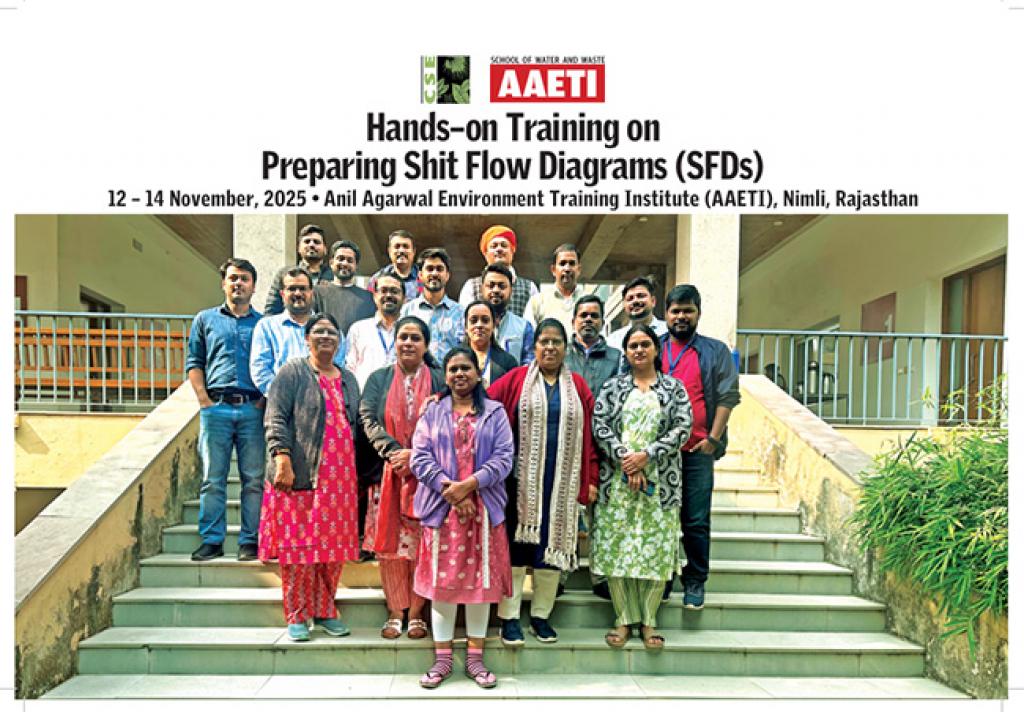
The Centre for Science and Environment (CSE) conducted a three-day residential Hands-on Training on Preparing Shit Flow Diagrams (SFDs) for professionals from the Centre for Advocacy and Research (CFAR) from 12–14 November 2025 at the Anil Agarwal Environment Training Institute (AAETI), Nimli, Rajasthan. The training was designed to build a comprehensive understanding of sanitation service chains and strengthen participants’ abilities to analyse, interpret, and generate Shit Flow Diagrams—a globally recognized tool for visualizing safe and unsafe excreta flows in urban areas. The programme was facilitated by Harsh Yadava and Sarim from CSE, who led the sessions with strong conceptual clarity, practical experience, and an engaging training style.
Day-1, November 12, 2025
Participants arrived in Delhi on 11 November, visited the CSE headquarters, and then proceeded to AAETI. The training formally began on 12 November with participant introductions, room mapping, and an overview of CSE’s work on urban sanitation. CFAR representatives also shared their expectations and the purpose of initiating SFD development. A pre-training assessment using Mentimeter helped gauge baseline knowledge and plan the depth of the upcoming sessions. The first day covered foundational concepts, beginning with faecal sludge and septagmanagement (FSSM), the relevance and evolution of SFDs, and India’s journey in adopting SFD-based planning—especially in Uttar Pradesh. Participants were introduced to reading SFD graphics, interpreting safe and unsafe flows, and understanding the terminology, variables, and definitions supported by the SFD manual. Group exercises and a video case study from Chunar enabled an interactive learning environment. The day concluded with feedback and open discussion, ensuring that every participant felt aligned with the upcoming technical components.
Day-2, November 13, 2025
The second day focused on the process of preparing SFDs. The morning began with a guided tour of AAETI’s green features, followed by a recap session. Participants then engaged in stakeholder identification exercises, which helped them map the actors involved across the sanitation value chain. Detailed sessions on data collection methodology, sanitation systems in India, and data triangulation were conducted, enabling participants to understand the importance of accuracy and verification in SFD preparation. They also practiced calculations related to septage and wastewater volumes. Post-lunch, the group visited the CSE Environmental Laboratory, where Dr. Rajarshi Banerjee explained lab operations and water-quality monitoring processes. The afternoon continued with a step-by-step demonstration of the SFD Graphic Generator, after which participants undertook their first “Do-It-Yourself” (DIY) SFD exercise in groups. This session allowed them to apply the day’s learning and build confidence in navigating the SFD tool.
Day-3, November 14, 2025
The final day, 14 November, was dedicated to completing the DIY SFDs and presenting them. Each group refined its SFD graphic, defended the assumptions made during data classification, and received detailed feedback from the trainers. This was a significant milestone as nearly half the participants had no prior exposure to SFDs at the start of the training, yet all groups were able to independently generate complete SFDs by the final day. Trainers later introduced the concept of context-adapted SFDs and guided participants through SFD reporting templates. The day concluded with feedback sessions, post-training assessment, certificate distribution, and a closing lunch before participants departed for their respective cities. Throughout the three days, the energy in the room remained high on both ends—trainers and trainees. Participants demonstrated exceptional enthusiasm, punctuality, discipline, and a strong desire to learn. Several participants acknowledged that the calm, patient, and methodical delivery of Harsh and Sarim made even technically dense sessions easy to follow. Their grounding in field experience and thorough subject command was evident in the clarity with which they explained every aspect of the training. This approach ensured that even those with no prior exposure to SFDs felt confident in developing them by the end of the course. The training successfully met its objectives. All participants gained hands-on experience in interpreting, analysing, and generating SFDs; understanding sanitation service chains; identifying stakeholders; and applying data triangulation. The exercises strengthened their analytical skills and provided them with practical tools that they can now apply in CFAR’s citylevel sanitation work across India. The training not only enhanced participants’ technical capabilities but also fostered a deeper appreciation for evidence-based sanitation planning.
Training Coordinator
Harsh Yadava
Programme Officer,
Centre for Science and Environment
Mo. +91 8709638775
Email: harsh.yadava@cseindia.org
Training Director
Subrata Chakraborty
Director, Water Programme,
Centre for Science and Environment
Email: subrata.chakraborty@cseindia.org
| Attendance | |
| Download pdf | |
| List of Participants | |
| Download pdf | |
| Participant’s feedback summary | |
| Download pdf | |
| Learning Objectives | |
By the end of the training, participants will be able to:
|
|
| Training Methodology | |
The programme blends theory with practical learning through:
|
|
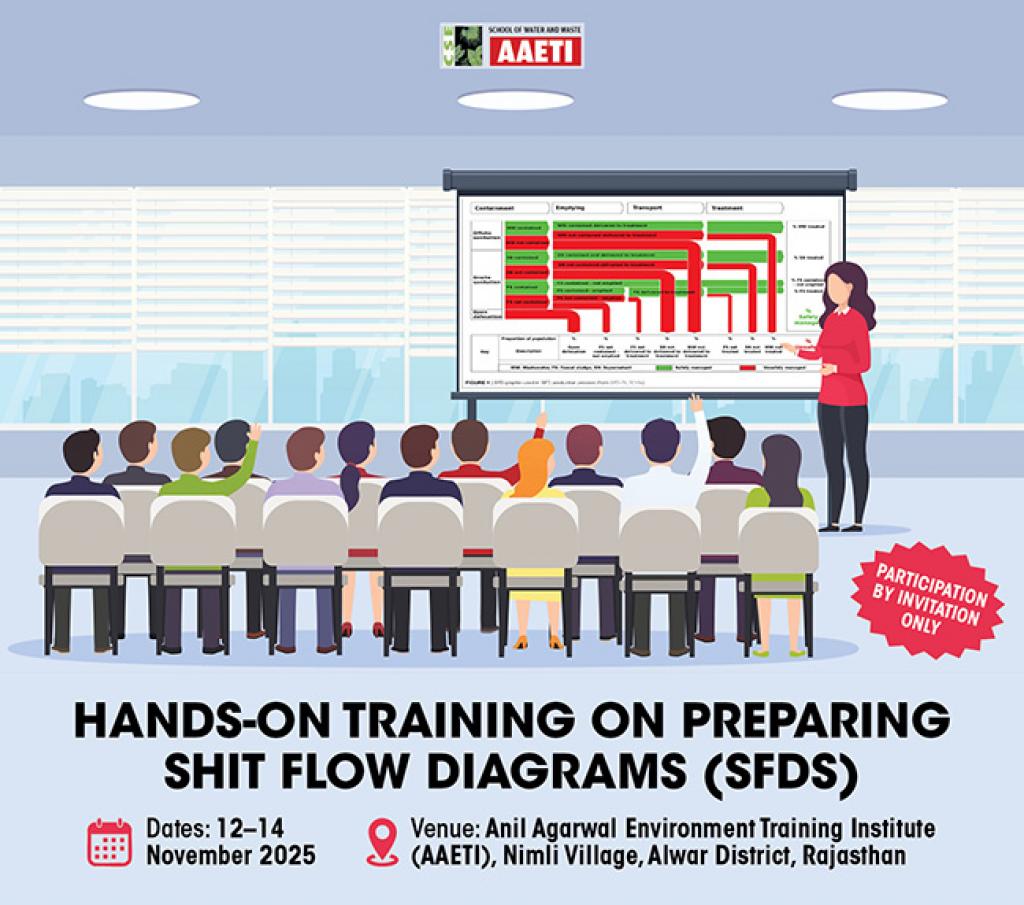
| Flyer | |
 |
|
| Download Flyer | |
| Previous workshops | |
| Training on: Preparation of SFDs for Sanitation Master Planning in Jodhpur Division Rajasthan | |
| Training on Preparation of Shit Flow Diagrams (SFDs) | |
| Anil Agarwal Environment Training Institute | |
 |
|
| Download here | Download here |
| Route Map for AAETI, Neemli, Rajasthan | |
| Weather in Nimli, Tijara, Rajasthan | |
Share this article