
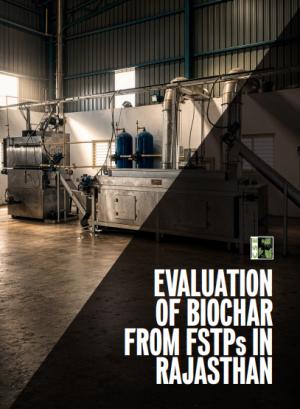
As urban centres across India’s largest arid state Rajasthan embrace decentralized sanitation, sustainable resource recovery has become a pressing environmental priority. This report on the evaluation of biochar from FSTPs in Rajasthan—a first-ofits-kind study by the Environment Monitoring Laboratory (EML) at the Centre for Science and Environment (CSE)-assesses 39 pyrolysis-based faecal sludge treatment plants (FSTPs) operating across central and eastern Rajasthan.
The report critically examines the performance of Omni Processor thermal (pyrolysis) technology for converting human waste into safe, valuable outputs: treated effluent, biosolids, and carbonnegative biochar. Using rigorous multi-parameter testing-including solids, organics, nutrients, heavymetal monitoring and pathogen analysis-the study benchmarks these facilities against Indian regulatory standards (MoEF&CC, NGT, FCO) and international guidelines (USEPA, WHO).
While underscoring biochar’s promise as a durable carbon sink and soil enhancer, the findings also reveal operational instabilities, process fluctuations and compliance gaps in smaller-capacity plants. Serving as both a roadmap and a troubleshooting guide, this report equips policymakers, urban local bodies and environmental engineers to strengthen sanitation systems and advance India’s circular economy.


Share this article