
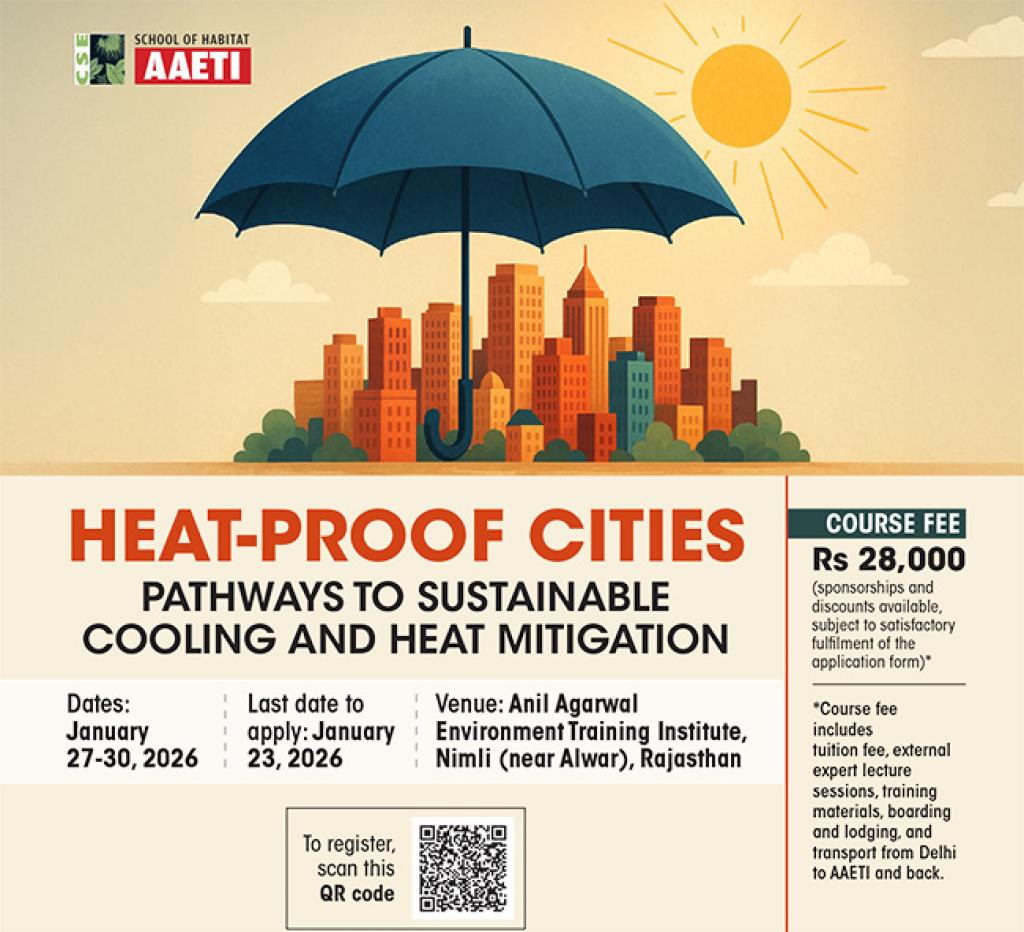
The world has warmed by about 1.5°C since pre-industrial times. With 2024 declared the hottest year on record and the past decade the warmest ever, cities have become the frontline of this crisis. As urban areas grow more heat-stressed, the demand for cooling continues to surge. Additionally, current cooling technologies release large amounts of waste heat into the environment, further intensifying the Urban Heat Island effect.
In India, space cooling demand in buildings is projected to rise 11-fold by 2038 compared to the 2017-18 baseline, which will drive up energy consumption. To address this issue, India has recognised the urgent need for a sustainable cooling transition. The India Cooling Action Plan (ICAP, 2019) targets to cut cooling demand across sectors by 20-25 per cent by 2037-38, among other national goals. Achieving this will require cities to revisit urban planning and design and adopt an approach that integrates cooling with the planning of the built environment. A cooling master plan can enable this and serve as a vital framework to structure and optimise city-wide cooling by combining nature-based solutions and Cooling as a Service, which includes not-in-kind technologies, energy-efficient systems and scaling up of renewable or alternative energy sources.
Centre for Science and Environment (CSE) is offering a four-day training programme that will equip participants with an advanced methodology to plan and design cities that not only adapt to rising heat but also actively reduce it. The programme will also cover how to implement these cooling strategies and support long-term climate mitigation.
Salient features
Course Coordinator
Sugeet Grover
Programme Manager
Sustainable Habitat Programme, CSE
+91 9818443366
sugeet.grover@cseindia.org
Course Director
Rajneesh Sareen
Programme Director
Sustainable Habitat Programme, CSE
rajneesh.sareen@cseindia.org
| Flyer | |
|
|
| Download Flyer | |
| Course Fee | |
| Rs 28,000 (sponsorships and discounts available, subject to satisfactory fulfilment of the application form)* *Course fee includes tuition fee, external expert lecture sessions, training materials, boarding and lodging, and transport from Delhi to AAETI and back. |
|
| Who can apply? | |
| Officials from urban local bodies and other government departments, pollution control officials, regulators, architects, engineers, planners, builders/developers, researchers and anyone interested in sustainable built environment. | |
| Certificate | |
| Participants will be awarded a certificate on completion of the training | |
| Venue | |
| Anil Agarwal Environment Training Institute | |
 |
|
| Download here | Download here |
| Route Map for AAETI, Neemli, Rajasthan | |
| Weather in Nimli, Tijara, Rajasthan | |
| Previous Training | |
Share this article