

Free download of the CSE report
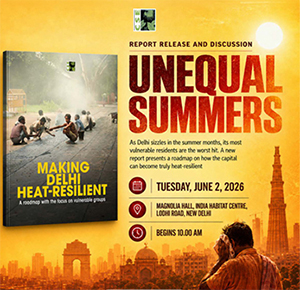
New Delhi, June 2, 2026: “Delhi is in the grip of an escalating urban heat crisis: dangerously high ‘feels-like’ temperatures are causing fatalities, and are projected to result in severe economic losses equivalent to – as a McKinsey analysis says -- up to 4.5 per cent of India’s gross domestic product (GDP)” – says a new report from Centre for Science and Environment (CSE) released here today to mark the Global Heat Action Day.
According to the report, “geospatial analysis confirms that 75.78 per cent of Delhi’s area is persistently heat-stressed, a condition worsened by the dramatic shrinking of the city’s green cover. Current actions to contain this crisis are proving to be insufficient because of a lack of a targeted resilience strategy for highly vulnerable groups such as construction workers, street vendors and informal settlement dwellers, many of whom reside or work in heat hotspots.”
Making Delhi Heat-Resilient, as the report is titled, says that in 2025, the ‘feels-like’ temperatures in Delhi reached as high as 52°C, as per the India Meteorological Department (IMD). In 2024, the Union Ministry of Health and Family Welfare had reported 25 heat-related deaths in the city –independent reports put this number at more than 55.
Speaking on the methodology adapted by the CSE study, Rajneesh Sareen, the Centre’s programme director for sustainable habitat, says: “We began by gathering evidence on the spatial disparity of heat seen in the city. Landsat data was analysed to identify heat spots and spatial changes in the natural heat sinks.A threshold of 45°C Land Surface Temperature (LST) was considered: areas which breached this value repeatedly for more than six years were identified as heat-stressed.”
The study also identified and pinpointed the locations of vulnerable population groups – the spatial distribution of these groups was overlaid with heat-stressed areas.
What did the CSE study find
According to Mitashi Singh, programme manager, sustainable habitat, CSE: “The CSE report’s estimations and observations match what is happening in Delhi currently. On May 25, 2026, Delhi's land surface temperature ranged from 31.59°C to 54.61°C, with a city-wide mean of 43.15°C. The highest surface temperatures -- exceeding 50°Cin many cases -- were observed in the western, north-western and south-western parts of Delhi, particularly in Karala, Mundka, Begumpur, Bawana, Chhawla and Khera.”
She adds: “Delhi recorded its warmest May night in nearly 14 years on May 25,2026 with 32.4°C. According to the India Meteorological Department (IMD), on May26, maximum temperatures ranged from 43.5°C at Safdarjung and 44.8°C at Ayanagar to 44.6°Cat Ridge, highlighting the widespread intensity of the heat across Delhi.”
What does the CSE study recommend?
Why is Delhi in this state in summers? The reasons range from its dense built form, shrinking green and blue spaces, buildings that do not have appropriate shading and insulation, layouts that are not designed to support ventilation, and surfaces that trap heat and waste from ACs and vehicles.
Says Sareen: “Delhi’s vulnerable communities, which constitute 50 per cent of the city’s population, do not have adequate means to adapt to the rising heat and are impacted more severely (compared to the more well-off residents). They toil through the day to earn their daily bread – this becomes brutal when the nights do not provide any respite either. To add to this, if there is a heat-related disruption in work – if they fall sick – it means wage losses.”
He adds: “While city heat action plans acknowledge the different vulnerable groups in Delhi,they do not offer any strategies that can increase their resilience. In the absence of such action, Delhi will see more and more people being affected by rising temperatures. The city needs a scientific and systematic response for its vulnerable populations.”
The CSE report says that the soaring temperatures are pushing citizens to resort to air-conditioners – Singh points out that Delhi’s peak power demand recently reacheda high of 8,231 MW.The rise in AC use strains the energy systems and aggravates the urban heat island effect. A running AC ejects heat into the ambient environment and heats up the air-shed of those who rely on the outdoor environment for cooling. “Essentially, it spurs cooling inequity,”says the report.
The CSE study proposes a dual-strategy roadmap to address this. It includesimplementing year-round, city-wide actions such as mandating thermally
efficient roofs in industrial areas, office complexes, markets and informal settlements; recognising heat as a notified disaster; developing a heat dashboard; implementing climate-appropriate planning and passive design principles in newbuildings and in those that need retrofitting; developing public cooling infrastructure; leveraging existing schemes and climate funds for heat management among others.
The second strategy includes focused interventions for exposed populations such as enforcing mandatorycooling breaks, staggering work timings, developing standard operating procedures, and dedicated fiscal, medical and supportduring extreme heat emergencies.
See the CSE report (Chapter 7) for a comprehensive Action Plan for Delhi.
Says Anumita Roychowdhury, CSE’s executive director and the head of its sustainable urbanisation teams: “Addressing heat vulnerability now requires an active heat management approach. Most important is not looking at it as an occasional occurrence but a harsh reality that is going to stay or perhaps even worsen. This has nowbecome vital for cities to make them liveable in climate-risked times.”
For more information, interviews etc, please contact Sukanya Nair of The CSE Media Resource Centre: sukanya.nair@cseindia.org, 8816818864

Share this article