
Faecal Sludge and Septage Management (FSSM) is a critical component of urban sanitation, particularly in towns without sewerage networks. Although Rajasthan achieved Open Defecation Free (ODF) status under the Swachh Bharat Mission (SBM) in 2018, sustaining safe sanitation requires effective collection, transportation, treatment, and safe disposal of faecal sludge and septage.
To strengthen FSSM, the Directorate of Local Bodies (DLB), Government of Rajasthan, has sanctioned nearly 200 Faecal Sludge Treatment Plants (FSTPs) for non-sewered Urban Local Bodies (ULBs), while the Panchayati Raj Department has approved 100 cluster-based FSTPs for rural areas. The state currently has more than 60 operational FSTPs, with several more under construction.
As FSSM infrastructure expands, building the capacity of municipal officials has become essential for ensuring effective planning, operation, monitoring, and sustainable service delivery. Assessments by the Centre for Science and Environment (CSE) have highlighted challenges such as limited technical knowledge, inadequate monitoring, low plant utilisation, and weak regulatory compliance.
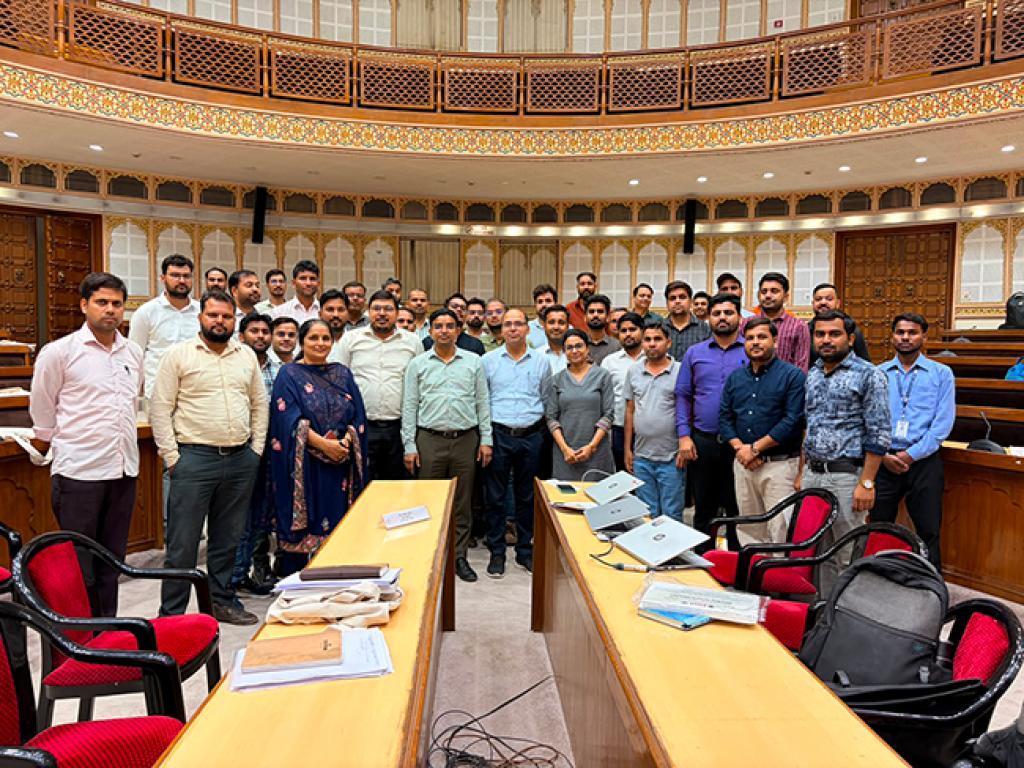
To address these gaps, CSE, in collaboration with the Swachh Bharat Mission (Urban) and the Directorate of Local Bodies (DLB), Government of Rajasthan, has launched a series of Divisional-Level Training Programmes on the Operation and Maintenance of FSSM Systems. The first programme, held on 26 June 2026 in Jaipur, brought together over 70 engineers and officials from more than 70 Urban Local Bodies across the Jaipur Division.
The training programme aimed to strengthen the technical understanding and implementation capacities of municipal officials involved in sanitation service delivery. It provided participants with practical knowledge on FSSM planning, treatment technologies, operation and maintenance of Faecal Sludge Treatment Plants (FSTPs), regulatory and institutional frameworks, Information, Education and Communication (IEC) strategies, and approaches for improving the performance and sustainability of sanitation systems across Rajasthan.
Training Methodology
The programme adopted a participatory and practice-oriented learning approach, combining technical knowledge with interactive sessions. It included expert presentations, case studies, quizzes, experience-sharing sessions, and open discussions to encourage active participation and peer learning among officials from different Urban Local Bodies (ULBs).
The training commenced with an overview of the basics of Faecal Sludge and Septage Management (FSSM) and Rajasthan's progress, achievements, and future roadmap for strengthening sanitation infrastructure and services. Participants were then introduced to the sanitation value chain, characteristics of faecal sludge, and the importance of its safe collection, treatment, and disposal.
Technical sessions covered the policy, governance, and regulatory framework for FSSM in India, followed by discussions on FSSM planning, faecal sludge treatment technologies, and Performance-Oriented Procurement (PoP) approaches. Participants also received practical training on the operation and maintenance of Faecal Sludge Treatment Plants (FSTPs), including routine maintenance, performance monitoring, troubleshooting, record-keeping, occupational health and safety, and strategies to improve plant efficiency and utilisation.
A dedicated session on Information, Education and Communication (IEC) highlighted the role of behaviour change communication, citizen engagement, and awareness generation in strengthening FSSM implementation and promoting safe sanitation practices.
The programme concluded with an interactive open house, where participants shared field experiences, discussed implementation challenges, and exchanged best practices with experts and fellow practitioners. Overall, the blend of technical sessions, practical learning, and peer-to-peer interactions strengthened participants' capacities to effectively plan, operate, monitor, and manage FSSM services in their respective ULBs.
Training Coordinators
Jyoti Parsad Dadhich
Deputy Programme Manager, Water Programme
Centre for Science and Environment
Email - jyoti.parsad@cseindia.org
Mob. No. +91- 8559838864
Gaurav Singh
Assistant Engineer
Swachh Bharat Mission (Urban), Directorate of Local Bodies,
Local Self Government Department,
Government of Rajasthan
Training Director
Subrata Chakraborty
Director, Water Programme
Centre for Science and Environment
Email - subrata.chakraborty@cseindia.org
| Participation | |
| The programme is intended for executive officers, municipal engineers, treatment plant supervisors/operators, sanitation professionals, and representatives of agencies involved in the planning, implementation, O&M and monitoring of FSSM. | |
| Note | |
|
Share this article